

Do English-Taught Programs at Chinese Universities Still Require HSK Scores? Admission vs. Graduation Rules Explained (2026 Guide)
 715
715 08/26/2026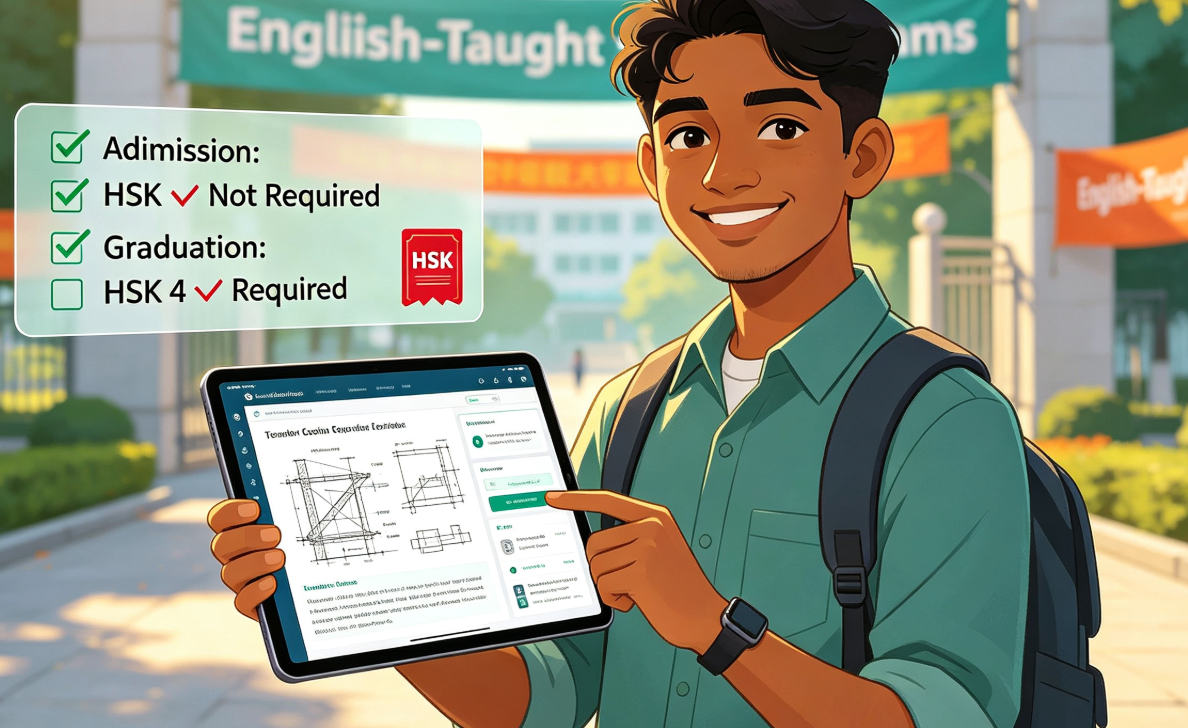
Quick Answer
For admission: in most cases, no. The majority of English-taught programs at Chinese universities do not ask for an HSK certificate at the application stage. Instead, you prove your English proficiency — typically IELTS 5.5–6.0 or TOEFL 72–80 for non-native English speakers, or a Medium of Instruction (MOI) certificate if your previous education was entirely in English.
For graduation: in most cases, yes. Under the Ministry of Education's 2018 national quality standards for international student education, English-taught bachelor's students are generally expected to reach HSK Level 4 (180+ points), and English-taught master's and PhD students HSK Level 3 (180+ points) before their degree is conferred. A growing number of universities write this rule directly into their degree-conferral policies.
Hundreds of international students every year apply to English-taught programs in China — MBBS medicine, engineering, international business, computer science — precisely because they believe Chinese language testing is entirely off the table. That belief is half right, and the half that is wrong can cost you your diploma if you discover it in your final semester.
This guide separates the two layers of the question: what universities require when you apply, and what they require when you graduate. All policies cited below come from official university admissions documents and national regulations current as of the 2026 intake.
1. What Counts as an English-Taught Program?
English-taught programs (ETPs) are degree programs at Chinese universities in which all core courses, lectures, assignments, and examinations are delivered in English. They have expanded rapidly over the past decade as Chinese universities internationalize, and the most common offerings include:
MBBS (Bachelor of Medicine and Bachelor of Surgery) — the flagship English-taught medical degree
Engineering majors — computer science, software engineering, electronic information, mechanical and electrical engineering
Business and economics — international business, international trade, finance, management
China-focused social sciences — international relations, Chinese economy, contemporary China studies
These programs exist at every tier of the Chinese university system, from C9 universities such as Fudan and Xi'an Jiaotong to provincial medical universities. Importantly, the language of instruction determines which language requirements apply to you — so the first step of any application is confirming, in the official admissions brochure, that your target program is genuinely English-taught rather than bilingual.
2. Admission: HSK Is Usually Not Required for English-Taught Programs
The general rule
For the vast majority of English-taught programs, no HSK certificate is required at the application stage. Universities instead verify your English proficiency. The most common benchmarks in 2026 brochures:
IELTS (Academic): typically 5.5 to 6.0 or above
TOEFL iBT: typically 72 to 80 or above
MOI certificate: if your previous degree was taught entirely in English, many universities accept a Medium of Instruction certificate issued by your school in place of IELTS/TOEFL
Native English speakers: usually exempt from English testing entirely
Real examples from 2026 admissions brochures
University of Electronic Science and Technology of China (UESTC) states plainly in its international undergraduate brochure: English-taught programs impose no Chinese proficiency requirement on applicants, while non-native English speakers must provide TOEFL 80+ or IELTS 5.5+ (Chinese-taught programs, by contrast, require HSK 5 with 180+). English-taught undergraduate tuition is 20,000 RMB per year, with applications open from December 1 to June 30.
Donghua University's 2026 undergraduate guide requires IELTS (Academic) 5.5 or TOEFL iBT 72 for English-taught applicants, with no HSK requirement — and explicitly allows applicants whose high school education was entirely in English to substitute a school-issued proof of instruction language. Its entrance academic test (CSCA) for English-taught applicants covers mathematics only, answered in English.
Hainan Province's regulations on international student management codify the same logic: applicants to English-taught programs from non-English-speaking countries must show TOEFL 78+ or IELTS 6.0+ — with no admission-stage HSK requirement.
Where HSK can still appear at admission
A few edge cases are worth knowing before you assume HSK is irrelevant:
Some competitive programs add Chinese as a bonus criterion. A handful of bilingual or China-focused programs list "basic Chinese proficiency preferred" or award scholarship points for HSK certificates, even when they are not mandatory.
Preparatory-to-degree pathways sometimes embed HSK benchmarks if you later switch into a Chinese-taught program.
Individual university policies change year to year. What was true in the 2025 brochure may not hold in 2026 — always verify against the current year's official document for your specific program.
3. Graduation: The HSK Requirement That Catches Students Off Guard
The national policy floor
The single most important document on this topic is the Ministry of Education's Quality Standards for Higher Education of International Students in China (Trial) (《来华留学生高等教育质量规范(试行)》, Jiao Wai [2018] No. 50). It establishes minimum Chinese proficiency expectations for international students completing degrees in China, regardless of the language of instruction:
Chinese-taught bachelor's, master's, and PhD programs: HSK Level 5 (180+ points) at graduation
English-taught bachelor's programs: HSK Level 4 (180+ points) at graduation
English-taught master's and PhD programs: HSK Level 3 (180+ points) at graduation
The logic is straightforward: a graduate who has lived in China for four years should be able to function in Chinese — in daily life, in basic professional interactions, and in understanding the society around them. The standard sets a floor, not a ceiling, and universities may set higher bars.
How universities implement it
Enforcement varies, and this is where "part of the universities" in our topic becomes visible. Policies published by individual universities show the spectrum:
University of International Business and Economics (UIBE) has one of the clearest policies: HSK 4 (180+) for English-taught undergraduates and HSK 3 (180+) for English-taught postgraduates before degree conferral.
China Pharmaceutical University states in its policy that failure to submit a valid HSK certificate delays degree conferral — and that submitting a falsified certificate results in immediate degree revocation and removal from the national higher education records system (CHSI).
Wenzhou Medical University requires HSK 4 (180+) for its English-taught undergraduates; Zhejiang University of Science and Technology applies the same HSK 4 / HSK 3 split.
Chongqing University and Lanzhou University list HSK 4 (180+) for English-taught bachelor's students and HSK 3 (180+) for English-taught graduate students.
Hainan Province goes further than the national floor: its regulations require English-taught international students to obtain an HSK 4 or above certificate before graduation as a condition for issuing the diploma and degree certificate.
At the other end of the spectrum, several major universities — including Wuhan University, Xiamen University, Jilin University, Nankai University, Northeastern University, and East China Normal University — do not list an HSK graduation requirement for their English-taught streams in currently published policies.
Beyond the certificate: mandatory Chinese courses
Some universities satisfy the national standard through curriculum rather than exit exams. Nanjing University requires international undergraduates to earn 12 Chinese language course credits (4 for graduate students). Chongqing University and UESTC require all degree-seeking international students — whatever the teaching language — to complete compulsory courses in Chinese Language and Overview of China as graduation conditions. In these models, passing the coursework matters even if you never sit a public HSK exam.
4. Special Case: English-Taught MBBS and Clinical Programs
Medical programs deserve their own warning. If you study MBBS in English, your final two years involve hospital rotations, patient histories, and clinical communication — in Chinese hospitals. Universities therefore attach real HSK stakes to medical degrees:
Nanjing Medical University requires MBBS graduates to reach HSK 3.
Wenzhou Medical University requires HSK 4 (180+) for its English-taught undergraduates — above the national floor for other majors.
Clinical supervisors at many teaching hospitals expect functional spoken Chinese well before the exit exam, because ward work starts years earlier than graduation.
If you are heading into any patient-facing program, plan your HSK preparation from year one, not year four.
5. Practical Details: Validity, Costs, and the New HSK 3.0
Certificate validity. HSK certificates are generally treated as valid for about two years for admission purposes, but for graduation purposes several universities accept certificates obtained within a wider window — China Pharmaceutical University, for example, accepts certificates issued up to eight years before the graduation year. Confirm your university's rule early.
Test fees. In 2025–2026, HSK fees range from about 150 RMB (HSK 1) to 650 RMB (HSK 6), plus separate fees for the HSKK speaking test where required.
Passing scores. For HSK Levels 3 to 6, the passing line is 180 out of 300. That means the HSK 4 (180+) graduation floor is a reachable target for a student who studies steadily alongside an English-taught degree.
HSK 3.0 transition. The new HSK 3.0 framework (nine levels in three bands) is being rolled out; if you take the test before the transition at your test center, you will sit the current format. Check with your test center about which version applies to your planned exam date, and prepare with materials matched to that version.
6. Why Learn Chinese Anyway? The Case Beyond Requirements
Even if your target university imposes no HSK requirement at any stage, treating Chinese as optional is a strategic mistake:
Career leverage. Graduates combining an English-taught technical degree with functional Mandarin are disproportionately recruited by multinationals, Chinese tech firms expanding overseas, and companies trading with China. The bilingual profile is the differentiator.
Scholarship renewal and extension. For Chinese Government Scholarship (CSC) students, demonstrable Chinese progress strengthens renewal cases and applications for further study. CSC also funds up to one year of Chinese language preparation for eligible categories.
Daily life quality. Banking, hospital visits, rental contracts, delivery apps, and bargaining at markets all become dramatically easier with even HSK 3–4 level Chinese.
Campus and social integration. English-taught programs can become bubbles; students who break out of them report better internships, friendships, and research opportunities.
7. A Realistic HSK Planning Timeline for English-Taught Students
Scenario A: English-taught bachelor's with an HSK 4 graduation requirement
Year 1: take a placement assessment, start structured self-study or elective Chinese courses (aim: HSK 1–2 by year end).
Year 2: reach HSK 3 level; sit HSK 3 if your university accepts progression evidence — this also covers internships requiring Chinese.
Year 3: sit HSK 4 (180+). Doing it in year 3, not year 4, leaves room for one retake.
Year 4: focus on your thesis; submit the certificate with graduation paperwork.
Scenario B: English-taught master's with an HSK 3 graduation requirement
Semester 1: assessment + 3–5 hours of Chinese per week; target vocabulary for daily life.
Semester 2: monthly mock tests; sit HSK 3 in the summer — a full year before graduation.
Year 2: optional HSK 4 attempt for career value; certificate submitted at graduation.
Scenario C: no graduation requirement at all
Still complete a free level assessment in semester 1 to set a baseline.
Aim for functional HSK 3 by graduation through consistent weekly practice — the minimum for comfortable daily living and internship hunting in China.
8. How to Prepare Efficiently Alongside an English-Taught Degree
You will not have a preparatory year's worth of class hours — English-taught students juggle full degree course loads. That makes preparation efficiency the deciding factor:
Assess first. A free 3-minute level assessment tells you your true starting point and how far HSK 4 (or HSK 3) actually is.
Practice in the new HSK framework. Whether your exam date falls under the current format or HSK 3.0, train on materials aligned to the syllabus you will actually face.
Use AI feedback loops. Between classes, AI-powered speaking and writing feedback compresses correction cycles from weeks to minutes — crucial when Chinese study competes with degree coursework.
Take full timed mock exams monthly. Computer-based mock exams that reproduce the real test environment build the stamina and interface familiarity that self-study alone cannot.
Track predicted scores against your university's threshold. Knowing your trajectory tells you when to book the real exam — and whether one retake budget is enough.
On hsktest.ai, English-taught students can take the free level assessment, practice across HSK levels 1–9 with instant AI feedback, sit full mock exams replicating the official computer-based test, and use the university matching tools to check the HSK requirements — admission and graduation — of specific Chinese universities before committing to a program. Students on the platform report an average improvement of 23 points within 8 weeks; spread over a degree timeline, that consistency is exactly what turns a graduation requirement into a career credential.
9. Frequently Asked Questions
Do I need HSK to apply for an English-taught program in China? Usually not. Most English-taught programs require proof of English proficiency (IELTS 5.5–6.0, TOEFL 72–80, or an MOI certificate) instead. A minority of programs treat HSK as a bonus or preferred item. Always check the current-year brochure for your specific program.
Do I need HSK to graduate from an English-taught program? In many universities, yes. Under the MOE's 2018 quality standards, English-taught undergraduates are expected to reach HSK 4 (180+) and master's/PhD students HSK 3 (180+) before degrees are conferred — and universities such as UIBE, China Pharmaceutical University, Wenzhou Medical University, Chongqing University, and Lanzhou University enforce this in writing. Others impose compulsory Chinese coursework instead, and some list no requirement.
Can I get a CSC scholarship for an English-taught program without HSK? Yes. English-taught CSC scholarship applications generally do not require an HSK certificate — English proficiency evidence suffices. CSC additionally funds up to one year of Chinese language study for eligible categories, which many English-taught students use to build HSK credentials.
Is the rule different for MBBS? Yes, and stricter. Because clinical rotations require patient communication, English-taught medical programs commonly enforce HSK 3–4 before graduation — for example, HSK 3 at Nanjing Medical University and HSK 4 at Wenzhou Medical University.
How long is my HSK certificate valid? About two years for admission purposes at most universities; for graduation purposes, some universities accept certificates issued up to eight years before graduation (e.g., China Pharmaceutical University). Verify with your international student office.
Which universities do not require HSK at graduation for English-taught programs? Several major universities — including Wuhan University, Xiamen University, Jilin University, Nankai University, Northeastern University, and East China Normal University — do not currently list such a requirement. Policies change annually, so confirm with the latest official documents before relying on any list.
Key Takeaways
Admission and graduation are two different questions. HSK is usually not required to enter an English-taught program, but is commonly required — HSK 4 (180+) for bachelor's, HSK 3 (180+) for master's/PhD — to receive the degree.
The national floor comes from the MOE's 2018 quality standards (Jiao Wai No. 50); universities such as UIBE, China Pharmaceutical University, Wenzhou Medical University, Chongqing University, and Lanzhou University enforce it explicitly, while some replace it with compulsory Chinese coursework.
MBBS students face stricter requirements (HSK 3–4) because of clinical rotations — start Chinese in year one.
Even without any requirement, HSK 3–4 level Chinese measurably improves scholarships, internships, careers, and daily life in China.
Plan the exam for year 3 of a bachelor's or semester 3 of a master's, leaving retake margin — and combine steady weekly study with level assessment, AI feedback, and timed mock exams on platforms like hsktest.ai.


