

How Long Is a Chinese Language Preparatory Program in China for International Students? Do You Still Need HSK After Finishing It? (2026 Guide)
 686
686 08/26/2026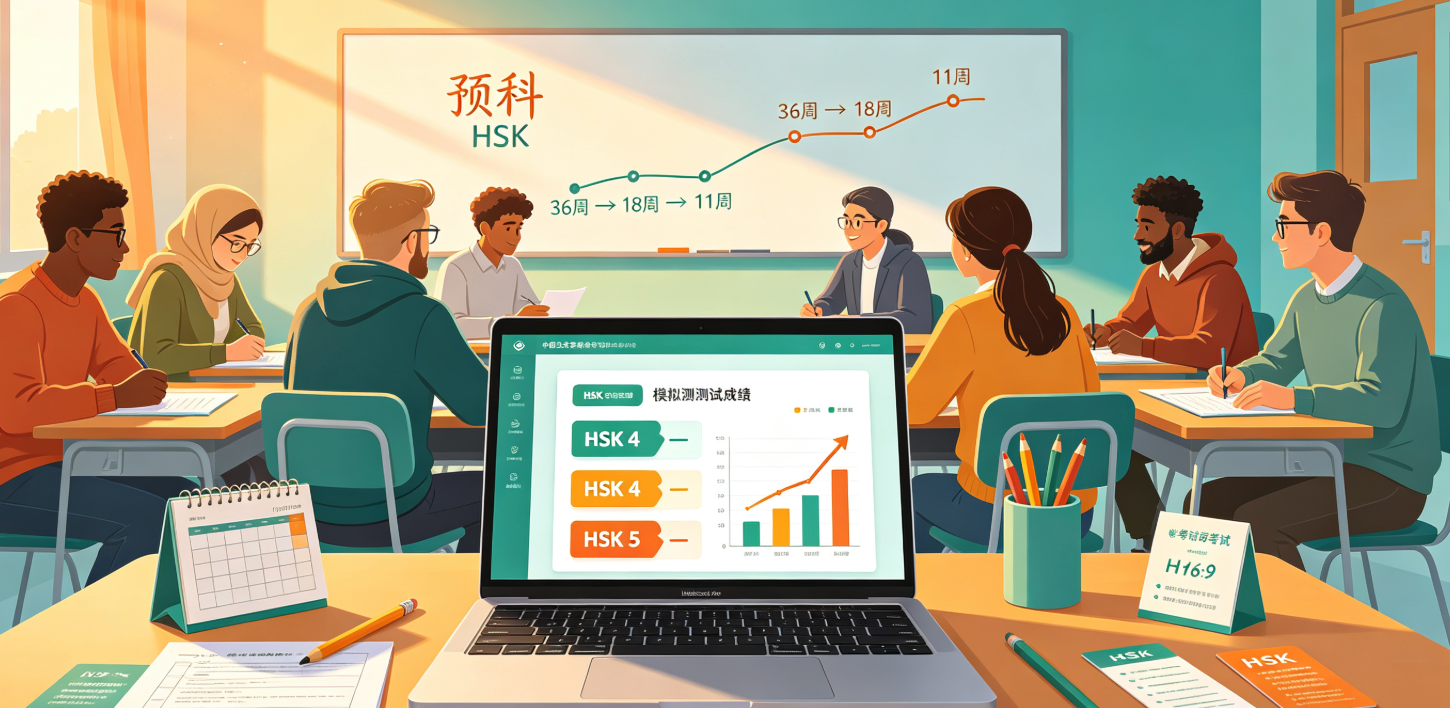
Quick Answer
How long? The standard Chinese language preparatory program (预科, yùkē) runs one academic year — two semesters, about 36 teaching weeks, with 20–26 class hours per week. Students who already hold HSK 2–4 can often shorten this to one semester (about 18 weeks) or join intensive 11-week tracks.
Do you still need HSK afterwards? In most cases, yes. A preparatory completion certificate alone is not accepted as a substitute for a valid HSK certificate by most Chinese universities and scholarship bodies. Chinese-taught bachelor's programs generally require new HSK 4 (180+ points); top universities typically require HSK 5; master's and doctoral programs usually require HSK 5–6.
Every year, thousands of international students arrive in China with a university offer in one hand and a study plan that starts not with their major, but with Chinese characters. Before you can attend lectures in engineering, economics, or traditional Chinese medicine, you first need to survive them in Mandarin. That is exactly what the Chinese language preparatory program — known in Chinese as yùkē (预科) or yǔyán yùkē (语言预科) — is designed for.
But two questions dominate nearly every applicant's mind: how long will this take, and after finishing the preparatory year, will I still have to sit the HSK exam? The short answers are "usually one year, but sometimes much less" and "almost certainly yes". The details below — drawn from official 2026 admissions brochures published by Chinese universities — will help you plan realistically.
1. What Is a Chinese Language Preparatory Program?
A Chinese language preparatory program is a non-degree bridging program run by Chinese universities for international students who intend to enter a Chinese-taught degree program but do not yet meet the language requirement. Its goals are threefold:
Language proficiency — building the listening, speaking, reading, and writing skills needed for academic study, typically targeting HSK 4 or HSK 5.
Academic foundations — many programs add mathematics, basic subject terminology (for example, "science Chinese" for engineering-track students), and academic skills such as report writing.
Cultural orientation — courses like Overview of China are a required component under China's national quality standards for international student education (《来华留学生高等教育质量规范(试行)》, MOE document Jiao Wai [2018] No. 50), helping students adapt to Chinese classrooms and daily life.
Preparatory programs differ from ordinary "Chinese language training" (汉语进修) in one crucial way: they are purpose-built for degree admission, and their curricula are aligned with the HSK benchmarks and subject requirements of the follow-on degree programs.
2. How Long Does a Preparatory Program Last?
The standard answer: one academic year (about 36 weeks)
The most common structure — seen at institutions such as Beijing University of Technology (北京工业大学) and Xi'an International Studies University — works as follows:
Total duration: 1 academic year, organized into 2 semesters
Teaching weeks: 16–18 weeks per semester, roughly 32–36 weeks in total
Class hours: 20–26 hours per week
Start dates: September (autumn intake); some programs also offer March (spring) entry
Target level on completion: HSK 4 (180+) as a minimum; HSK 5 for science and elite tracks
For example, Beijing University of Technology's preparatory program runs one full year at 21,000 RMB in tuition, with two tracks: Class I for students with no Chinese foundation (targeting HSK 4-level ability for humanities, economics, and management majors) and Class II for students who already hold HSK 3 with 180+ points (targeting HSK 5-level ability for science and engineering majors).
The flexible answer: 11 to 18 weeks for students with a foundation
Not everyone needs a full year. Leading universities now run tiered tracks based on your entry-level Chinese. Xi'an Jiaotong University's 2026 International Foundation Program is a clear example:
Foundation track — 36 weeks. No HSK required at entry. Tuition: 25,800 RMB (2026).
Enhancement track — 18 weeks. Requires HSK 2–3 or equivalent. Tuition: 13,800 RMB (2026).
Intensive track — 11 weeks. Requires HSK 4 or equivalent. Tuition: 8,800 RMB (2026).
Similarly, Xi'an Peihua University's 2026 language preparatory brochure states that zero-basis students study for one academic year, while students holding HSK 3 or above can compress the program into a single semester (15,000 RMB per year). Shanghai University of Traditional Chinese Medicine charges 9,500 RMB per semester and requires HSK 2 (180+) for autumn entry or HSK 3 (180+) for spring entry.
What determines your actual program length?
Your starting level. The gap between your current Chinese and your target HSK requirement is the single biggest factor. Under the new HSK 3.0 standard, each level typically represents 150–300 additional class hours.
Your target program's requirement. A bachelor's program requiring HSK 4 (180) demands far less preparation than a top-tier program requiring HSK 5 (180+).
Weekly intensity. Full-time preparatory students study 20–26 hours per week — roughly double the pace of part-time language learning — which is why a one-year program can move a motivated student from zero to HSK 4.
University-specific policies. Some preparatory classes set their own entry bars. East China Normal University's preparatory program, for instance, requires HSK 4 (180 points) for first-semester entry and HSK 4 (220 points) for second-semester transfer admission — because its preparatory year aims above HSK 4.
3. Do You Still Need HSK After Finishing the Preparatory Program?
This is the question that catches the most applicants off guard, and the honest answer is: yes in most cases — and sometimes you need HSK more than once. Here is the breakdown by scenario.
Scenario 1: Applying for a Chinese-taught degree program — HSK certificate required
Virtually all Chinese-taught degree programs ask for an official HSK certificate as part of the application dossier. Typical benchmarks under the new HSK 3.0 framework:
Short-term study, exchange, and semester-long language programs: HSK 3
Chinese-taught bachelor's programs at most universities: HSK 4, total 180+
Competitive bachelor's programs: HSK 4, total 210+
Chinese-taught bachelor's at top universities (e.g., Peking, Tsinghua): HSK 5, 180+ or higher
Chinese-taught master's programs: HSK 5 (mainstream), some programs HSK 6
Chinese-taught PhD programs and humanities majors at top universities: HSK 6
A preparatory completion certificate (预科结业证书) documents that you finished the coursework; it does not certify a standardized proficiency level. That is why universities such as Shanghai University explicitly state that preparatory students who complete the program in July must reach HSK 4 (180+) to enter their Chinese-language undergraduate programs that September. The University of Shanghai for Science and Technology likewise advises its language-program students to obtain HSK 4 (180+) before applying to scholarship-funded undergraduate programs.
Scenario 2: You are a scholarship student — HSK gates your degree entry
Chinese Government Scholarship (CSC) students in certain categories receive up to one year of funded Chinese language preparation before their degree program. But this funded year is conditional: students must reach the required HSK level (commonly HSK 4 or HSK 5, depending on the program) before transferring into degree study. Failure to reach the threshold can mean an extension at your own expense or, in the worst case, termination of the scholarship arrangement. Note also that many universities' self-funded preparatory programs are not covered by CSC or Shanghai Government Scholarships — budget accordingly.
Scenario 3: Your university has an internal pathway — the main exception
A minority of universities operate "preparatory-to-degree" internal pipelines in which their own preparatory graduates are admitted to their degree programs based on internal examinations or completion standards, with the HSK benchmark embedded in the preparatory exit requirements rather than a separate public exam. Beijing University of Technology, for example, states that students who complete its preparatory program and pass the assessment can apply to its undergraduate programs, with preparatory graduates prioritized for undergraduate freshman scholarships. These arrangements are valid only within that university — if you plan to apply elsewhere, the HSK certificate is still the universal currency.
Scenario 4: Graduation requirements — HSK can appear a second time
Plan for HSK beyond admission. Some universities require students to reach HSK 5 before they can receive their degree certificate. The University of Shanghai for Science and Technology, for instance, requires HSK 5 for graduation from its Chinese-taught undergraduate programs — a degree certificate will be withheld otherwise. In other words, for many students the HSK journey is not "one and done" at admission; it continues through the degree itself.
4. A Realistic Planning Timeline
Scenario A: Zero Chinese foundation → bachelor's at a typical Chinese university
Month 0–12: one-year preparatory program (36 weeks, 20–26 hours/week), targeting HSK 4.
Take HSK 4 in the final months of the program — retake once if needed.
Apply for the degree program with HSK 4 (180+) plus your preparatory transcript.
During the degree: continue toward HSK 5 if your university requires it for graduation.
Scenario B: HSK 3 holder → September degree entry in the same year
Spring semester: 18-week enhancement preparatory track.
Sit HSK 4 in June–July.
Enter the bachelor's program in September without losing a year.
Scenario C: Targeting a top university (HSK 5+)
Budget 18–24 months of total language preparation, including the preparatory year.
Use AI-assisted speaking and writing feedback weekly, since HSK 5 writing and oral production are the most common bottlenecks.
Take a full mock exam monthly to track your predicted score.
5. How to Prepare for HSK Efficiently During Preparatory Study
Preparatory classes build your foundation, but the HSK itself is a standardized, timed, computer-based exam — and exam technique is a separate skill. Students who combine classroom study with structured mock testing consistently progress faster:
Take a level assessment before you apply so you are placed in the right preparatory track and do not pay for a longer program than you need.
Use realistic, timed mock exams aligned with the new HSK 3.0 syllabus to build stamina and interface familiarity before test day.
Get AI-powered speaking and writing feedback between classes — pronunciation, fluency, grammar, and structure are hard to self-correct, and feedback loops measured in minutes rather than weeks compound quickly.
Track your predicted score against your target university's threshold so you know exactly when you are ready to book the real exam.
On hsktest.ai, you can take a free 3-minute level assessment, practice all new HSK levels 1–9 with instant smart feedback, sit full mock exams that reproduce the official computer-based test environment, and — critically for the question in this article — use university matching tools that show which Chinese universities and scholarships your HSK level already qualifies you for. Students using the platform report an average improvement of 23 points within 8 weeks, which can be the difference between an 11-week intensive track and a full 36-week program.
6. Frequently Asked Questions
Can I skip the preparatory program entirely?
Yes. If you already hold the required HSK certificate (for most bachelor's programs, HSK 4 with 180+), you can apply directly to the degree program. The preparatory year is a bridge, not a mandatory stage.
Does the preparatory completion certificate replace the HSK certificate?
Almost never for external applications. It may carry weight only within the issuing university's own internal pathway. For applications, scholarships, and graduation checks, the HSK certificate remains the standard proof of proficiency.
Is the preparatory year covered by scholarships?
Certain Chinese Government Scholarship (CSC) categories fund up to one year of Chinese language preparation before degree study, but most universities' own preparatory programs are self-funded and explicitly excluded from CSC and municipal scholarships. Always verify with the specific university's international student office.
How many hours per week will I study in a preparatory program?
Typically 20–26 class hours per week across comprehensive Chinese, listening, speaking, writing, and subject foundation courses, plus homework and tutoring.
What HSK score do I need to graduate, not just to enter?
Requirements vary by university and major; some Chinese-taught undergraduate programs require HSK 5 before issuing the degree certificate. Check your target university's academic regulations early so your language plan covers both entry and exit requirements.


