

HSKTest.ai: All-in-One AI Chinese Learning Platform
 276
276 08/20/2026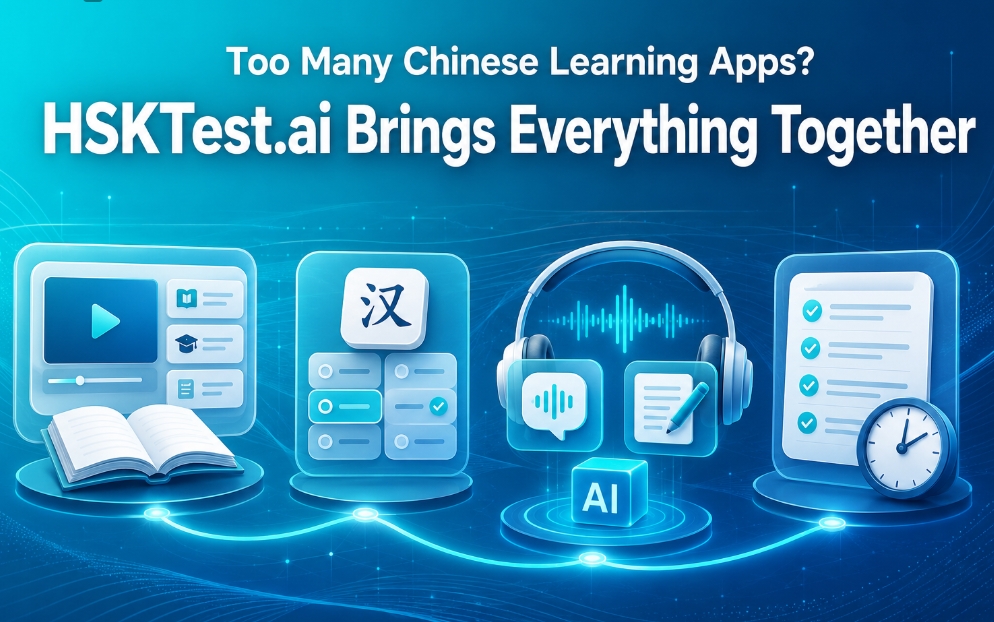
Too Many Chinese Learning Apps? HSKTest.ai Brings Everything Together
Learning Chinese should not require five different apps and a spreadsheet to keep everything organized.
Yet that is exactly how many learners study.
One app handles vocabulary. Another explains grammar. Listening practice comes from a video channel or podcast. Speaking and writing feedback may require a tutor or a separate AI tool. Then, when the HSK exam approaches, learners have to search again for practice questions, past-paper materials and realistic mock tests.
None of these resources is necessarily a bad choice. Many are excellent at what they do.
The problem is that learners are left to connect everything themselves.
They have to decide what to study, find suitable practice, track mistakes, identify weak areas and work out when they are ready to move on. Having more resources does not always make learning easier. Sometimes, it simply creates more decisions.
HSKTest.ai takes a different approach. It brings level assessment, structured courses, targeted practice, AI-powered feedback and HSK mock exams into one connected platform.
The value is not just having more content in one place. It is knowing what to do next.
The Real Problem Is Not a Lack of Resources
Chinese learners have more options than ever.
Vocabulary apps make daily review convenient. Video lessons can explain difficult grammar clearly. Online tutors offer real conversation and personal guidance. General AI tools are useful for open-ended questions. Question banks and mock-test websites help HSK candidates become familiar with the exam.
Each of these resources serves a purpose.
The challenge appears when they do not work together.
You may memorize a long list of words but still struggle to recognize them in a listening exercise. You may understand a grammar video but have nowhere to practice the structure. You may complete a mock exam, receive a score and still have no idea what to revise tomorrow.
At that point, you are not simply learning Chinese. You are also trying to design and manage your own curriculum.
For experienced learners, that may be manageable. For beginners and time-pressed HSK candidates, it often leads to unfocused study, repeated mistakes and long periods with no visible progress.
A more useful system should answer four questions:
What is my current level?
What should I learn now?
How should I practice it?
What should I do after seeing my results?
That is the gap HSKTest.ai is built to fill.
One Connected Path From Assessment to Improvement
HSKTest.ai is designed around a simple learning cycle:
Assess → Learn → Practice → Get feedback → Fix weak areas → Take a mock test → Adjust the plan
A learner can begin with a level assessment to establish a starting point. From there, the HSK learning center provides structured content across vocabulary, grammar, listening, reading, writing and culture.
After learning a new topic, students can move directly into the HSK practice center. Available activities include vocabulary cards, fill-in-the-blank questions, character practice, sentence ordering, dictation, speaking assessment, writing exercises and question-bank practice.
When it is time to measure progress, learners can take a timed HSK mock exam, review their performance and return to the areas that need more work.
This creates continuity between learning and testing. A lesson leads to practice. Practice produces feedback. Feedback informs the next lesson.
Instead of asking, “Which app should I open now?”, the learner has a clearer path forward.
Vocabulary Is More Useful When It Leaves the Flashcard
Vocabulary apps are good at helping learners recognize and review words. What they do not always show is how those words behave in real Chinese.
Knowing that 参加, 举行 and 报名 have different English translations is only the beginning. A learner also needs to understand which nouns and verbs commonly appear with them, how they sound in connected speech and which word fits a particular situation.
HSKTest.ai places vocabulary inside a broader learning context.
A student can first meet new words in a level-appropriate lesson, then reinforce them through flashcards, example sentences, dictation, fill-in-the-blank questions and reading practice.
Each activity checks a different part of vocabulary knowledge:
Flashcards test recall.
Audio builds sound recognition.
Dictation connects pronunciation with characters.
Example sentences show natural usage.
Sentence exercises reinforce word order and collocation.
HSK-style questions test recognition under exam conditions.
The goal is not simply to know what a word means. It is to recognize it, understand it and use it.
A Course Should Lead Somewhere
Courses are useful because they give learners a sequence. They can explain grammar, introduce vocabulary and break difficult skills into manageable lessons.
But watching a lesson can create a false sense of progress. Something may feel easy while the explanation is still on the screen. The real test comes when the learner has to use it independently.
That is why HSKTest.ai connects learning content with immediate practice.
After studying a word-order pattern, learners can try sentence-ordering exercises. After completing a vocabulary lesson, they can test the same words through listening, dictation or contextual questions. After learning a grammar structure, they can use it in writing instead of simply recognizing it in an explanation.
This makes it easier to distinguish familiarity from genuine understanding.
Learners who want a structured, self-paced program can explore the available HSK courses, then use the practice center to apply what they have learned.
The course provides direction. Practice confirms whether the knowledge has actually become usable.
More Questions Help—But Better Follow-Up Matters More
A strong question bank is an important part of HSK preparation. Learners need enough exposure to common question formats, high-frequency language points and realistic test tasks.
Past-paper materials and HSK-aligned questions can help students recognize patterns and build exam confidence. But doing more questions does not automatically solve the underlying problem.
Two learners may choose the same wrong answer for very different reasons.
One may not know the vocabulary. Another may misunderstand the grammar. A third may know the word in writing but fail to recognize it in audio. Someone else may understand the passage but run out of time.
A score alone cannot explain those differences.
The HSKTest.ai practice system combines question-bank practice with AI analysis and targeted follow-up. The aim is to help learners understand not only which answer was wrong, but what the mistake suggests they should work on next.
This shifts the focus from:
How many questions did I finish?
to:
What did these questions teach me about my Chinese?
That difference matters. Practice becomes more effective when every mistake leads to a specific action.
AI Feedback Where Independent Learners Need It Most
Speaking and writing are often the weakest parts of self-study.
It is easy to review vocabulary alone. It is much harder to judge your own pronunciation, tones, fluency, word order and written expression.
Recording yourself can help, but you may not hear the same problems a teacher would notice. Writing regularly is valuable, but progress is slow when corrections arrive days later—or not at all.
HSKTest.ai uses AI to provide more immediate feedback within the learning process.
Speaking assessment can help learners pay closer attention to pronunciation, fluency and grammar. Writing feedback can highlight problems involving vocabulary, sentence structure and expression. Practice results can also help reveal recurring weaknesses across different tasks.
AI does not have to replace a teacher. Human teachers remain especially valuable for nuanced conversation, cultural context and advanced expression.
The advantage of AI is availability. It can support the short, frequent practice sessions that happen between lessons. Learners can try, receive feedback, correct the problem and try again while the task is still fresh.
A Mock Test Should Change What You Study Next
Mock exams are essential for HSK candidates. They help learners become familiar with the test format, manage time and experience the pressure of completing several sections in one sitting.
However, a mock test is only useful if something happens after the score appears.
Taking test after test without changing the study plan may measure the same weaknesses repeatedly.
The HSK mock exams on HSKTest.ai are part of a wider preparation cycle. Learners can complete timed tasks, review their performance and return to the relevant courses or practice activities.
For example:
Weak listening results can lead to more audio and dictation work.
Slow reading can point to gaps in vocabulary recognition or reading fluency.
Frequent word-order mistakes can lead to sentence-building practice.
Writing problems can be addressed through AI-supported writing exercises.
Pronunciation and fluency issues can be explored through speaking assessment.
Repeated difficulty with one task type can lead to targeted question-bank practice.
In this system, a mock test is not the end of preparation. It is a diagnostic tool for the next round of learning.
AI Built Around the HSK Journey
General AI tools can explain a grammar point, translate a sentence or hold a conversation. Their flexibility is useful, particularly when learners have an unusual or highly specific question.
HSK learners, however, often need more than a one-time answer.
They need to know whether a topic is appropriate for their level, how it relates to the exam, which activities will reinforce it and whether the same weakness is appearing across multiple tasks.
HSKTest.ai applies AI within that specific context.
AI support appears throughout the learning journey:
At the beginning, it helps establish a starting point.
During practice, it provides timely feedback.
After an exercise, it helps identify the likely cause of an error.
After a mock exam, it highlights areas that need more attention.
During the next study cycle, it supports more focused practice.
The technology is not presented as a separate feature that learners have to work out how to use. It is built into the path from assessment to improvement.
A Continuous Route From Beginner to Advanced Chinese
A platform that works well for beginners may not have enough depth for advanced learners. Conversely, advanced exam materials can overwhelm someone who is still learning Pinyin, tones and basic sentence patterns.
HSKTest.ai organizes learning, practice and assessment across HSK 1–9.
Beginners can focus on pronunciation, core vocabulary, basic grammar and everyday communication. Intermediate learners can develop stronger listening, faster reading and more complete spoken and written expression. Advanced learners can work with increasingly complex language, including formal writing, professional topics, translation and cultural understanding.
The content becomes more demanding as learners progress, but the learning process remains familiar:
Learn something new. Practice it. Receive feedback. Test it. Improve it.
That continuity makes long-term study easier to manage. Learners do not have to rebuild their entire system every time they reach a new level.
A Learning Hub, Not a Replacement for Everything Else
No single platform can provide every kind of language experience.
Tutors offer personal interaction. Language partners make conversation spontaneous. Films, podcasts and graded readers expose learners to different voices, topics and styles. Real communication remains essential for anyone who wants to use Chinese confidently outside an exam.
HSKTest.ai is best understood as a central learning hub.
It can provide the structure that connects daily study with HSK goals:
An assessment establishes the starting point.
Courses introduce new knowledge.
The question bank turns knowledge into practice.
AI feedback supports speaking and writing.
Error analysis reveals weak areas.
Mock exams measure progress.
The results shape the next study plan.
Other resources can then be added for a clear reason rather than used at random.
This is not about forcing every learner to follow exactly the same method. It is about giving each learner a stable core around which the rest of their Chinese study can be organized.
Who Can Benefit From HSKTest.ai?
Beginners who need a clear starting point
New learners can use an assessment to understand their current level, then begin with suitable lessons and practice instead of guessing which resources to choose.
Self-learners who feel stuck
If progress has slowed, AI-supported analysis can help determine whether the main problem lies in vocabulary, grammar, listening, reading, speaking or writing.
Learners who need more speaking and writing practice
AI feedback makes it easier to include active language production in a regular study routine, even when a teacher is not immediately available.
HSK candidates who want structured preparation
Courses, targeted practice, an extensive question bank, HSK-aligned materials and realistic mock exams can be used as parts of one preparation process.
International students planning to study in China
For some learners, the HSK is part of a larger goal. The Study in China center helps connect language development with university and scholarship planning.
University and scholarship requirements vary, so learners should always confirm the latest criteria with the relevant institution.
One Platform, One Clearer Path
Chinese learners do not need another folder full of disconnected resources. They need a system that helps them use those resources in the right order.
HSKTest.ai brings together the main stages of the HSK learning journey:
Find your level.
Learn the right material.
Practice with purpose.
Get feedback while it still matters.
Focus on the skills holding you back.
Test your progress under realistic conditions.
Vocabulary apps, video courses, tutors, general AI tools and standalone question banks all have strengths. HSKTest.ai does not need to dismiss those strengths to offer something different.
Its advantage is connection.
Courses lead to practice. Practice creates data. AI turns that data into feedback. Mock exams reveal what to work on next.
Visit HSKTest.ai and begin with an assessment. Instead of piecing together your own HSK preparation system, follow one connected path toward stronger Chinese.


