

HSK 3.0 Writing: How to Get High Scores | Format Rules, Useful Sentences & Mistakes to Avoid
 506
506 08/17/2026
Writing is one of the most score-dividing sections in the new HSK 3.0 exam. Different from the simplified writing requirements of HSK 2.0, HSK 3.0 focuses heavily on standard format, logical coherence, authentic expression, and complete content structure.
Most overseas learners lose points not because of poor vocabulary, but due to non-standard writing formats, rigid sentence expressions and easily avoidable basic errors. This article exclusively targets the latest HSK 3.0 scoring standards, sorting out official format specifications, reusable high-score sentence patterns, and core pitfall avoidance strategies, helping overseas students get stable high scores in writing.
1. Official HSK 3.0 Writing Format Specifications (High Score Basis)
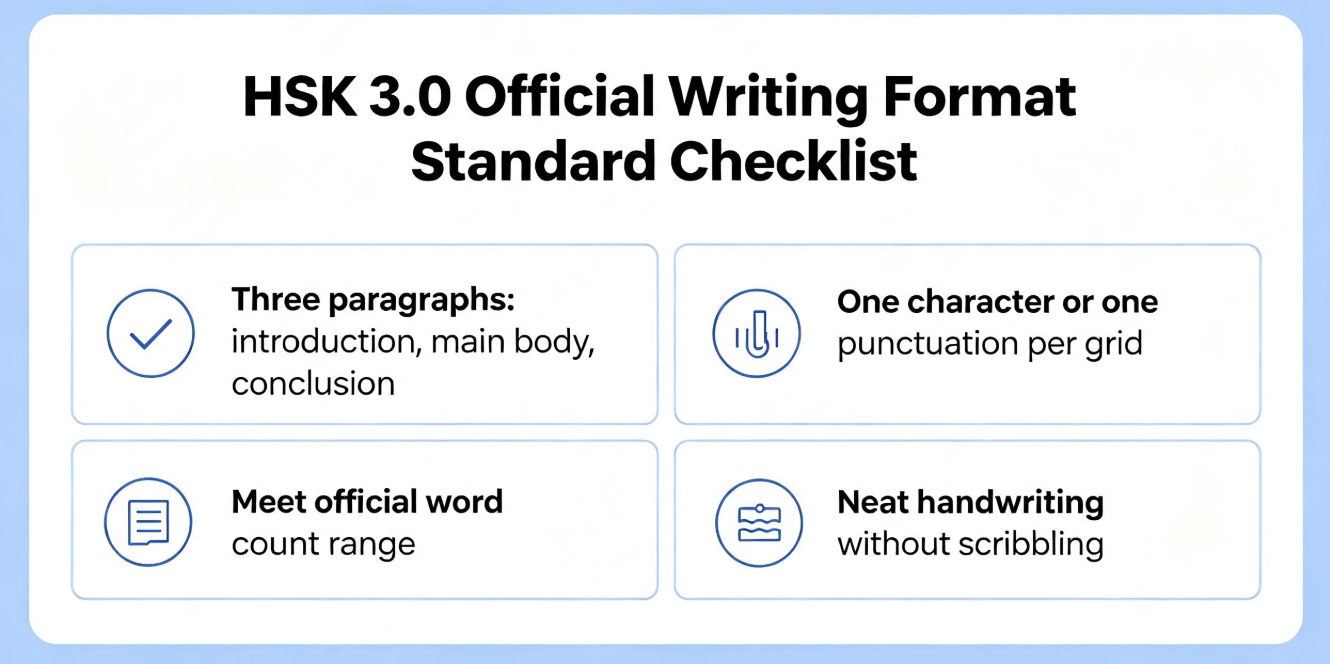
Format standardization is the primary scoring dimension of HSK 3.0 writing. Unstandardized layout will directly lead to fixed point deduction, even if the content is excellent. The following are mandatory official format rules for all levels:
1.1 Paragraph segmentation rules
Do not write all content in one single paragraph. A standard HSK 3.0 writing passage must be divided into 3 clear paragraphs: introduction, main body and conclusion. For short essay questions at intermediate levels, strictly follow the “opening + 2–3 key points + summary” structure to ensure complete logic hierarchy.
1.2 Character and punctuation norms
Each Chinese character and each punctuation mark occupies one independent grid. Do not pile up punctuation marks at the end of sentences, and avoid missing full stops. HSK 3.0 exam has stricter inspection on punctuation standardization than the old version, and irregular punctuation will cause continuous point deduction.
1.3 Word count standard for each level
Candidates must strictly meet the official word count range. Too few words lead to incomplete content, while excessive redundant sentences will reduce expression fluency. The word count requirements of HSK 3.0 are clearer and more refined, and strictly follow the official syllabus range is the basic guarantee for high scores.
1.4 Handwriting specification
Handwriting must be neat and standardized, without random stroke modification or scribbling. Illegible handwriting will affect the examiner’s reading judgment and lead to implicit score reduction, which is a common easily overlooked problem for overseas candidates.
2. High-Frequency Reusable High-Score Sentence Patterns (HSK 3.0 Exclusive)
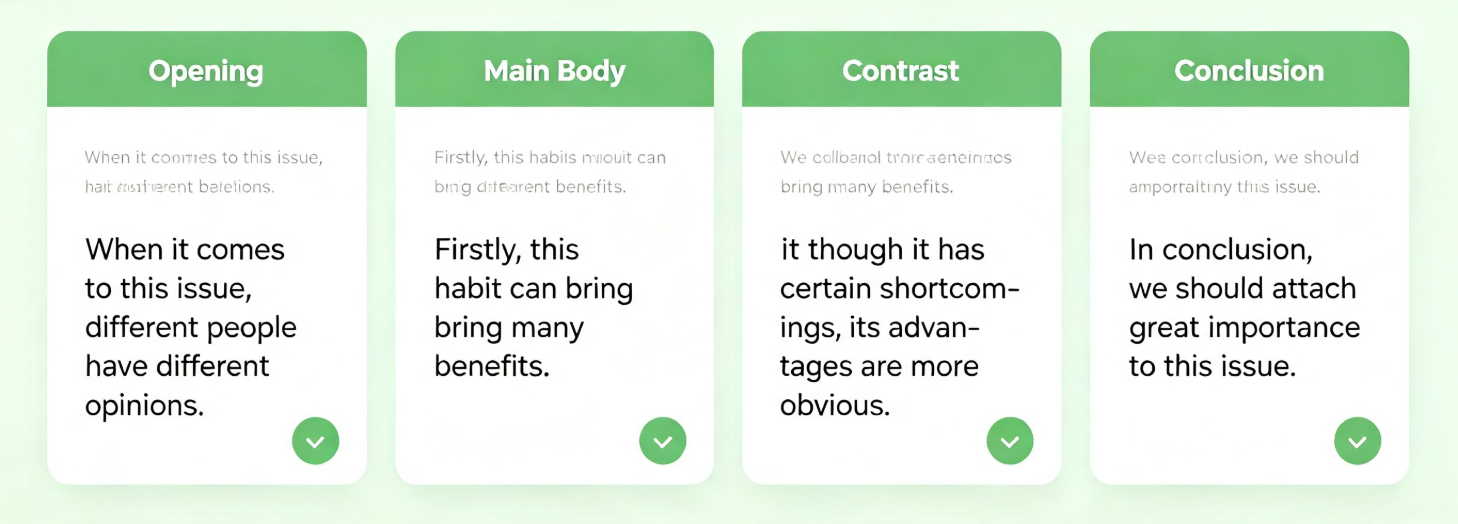
HSK 3.0 abandons simple single-sentence expressions and pays more attention to logical and diverse sentence structures. The following classified sentence patterns are highly matched with the new exam’s scoring preferences, suitable for all common writing topics such as daily life, study, hobbies, social phenomena and personal opinions.
2.1 Opening paragraph introductory sentences
In recent years, this topic has attracted more and more people’s attention in daily life.
When it comes to this issue, different people have different opinions.
This phenomenon is very common in our study and life, and it is worth discussing.
2.2 Main body logical expansion sentences
Firstly, this habit can bring many benefits to our study and daily life.
Secondly, it helps us improve our abilities and enrich our life experience.
In addition, keeping this good habit can make our life more colorful and meaningful.
2.3 Contrast and transition sentences
However, some people hold different views on this matter.
Compared with the past, great changes have taken place in this aspect.
Although it has certain shortcomings, its advantages are more obvious.
2.4 Conclusion summary sentences
In conclusion, we should attach great importance to this issue and develop good habits.
To sum up, this phenomenon has a positive impact on our study and life.
From my personal perspective, I will keep practicing and make continuous progress in this aspect.
3. HSK 3.0 Writing High-Frequency Mistakes & Avoidance Tips
Most overseas students’ writing score loss comes from repetitive low-level errors. Combined with the new scoring rules of HSK 3.0, we summarize the most typical mistakes and targeted correction methods:
3.1 Avoid rigid word-for-word translation
Many overseas candidates are used to translating English sentences directly into Chinese, resulting in awkward expression and non-local logic. HSK 3.0 focuses on authentic Chinese expression habits. It is better to use simple and standard fixed sentence patterns than to create complex wrong sentences blindly.
3.2 Avoid single sentence structure
Long-term use of short and simple sentences will lead to low writing scores. Properly use compound sentences with “because…, so…”, “although…, but…” and progressive conjunctions to enrich sentence hierarchy, which conforms to HSK 3.0’s scoring preference for logical expression.
3.3 Avoid inconsistent topic content
HSK 3.0 writing has stricter topic relevance inspection. Do not write redundant content unrelated to the topic for word count. All paragraphs and sentences must closely focus on the core theme to avoid score deduction for digression.
3.4 Avoid basic grammar and character errors
Wrong characters, confused word usage and incorrect tense are key deduction points. Before submitting the writing, reserve 1–2 minutes to check and correct low-level errors. For overseas learners, error-free basic expression is the core premise of high scores.
3.5 Avoid illogical paragraph layout
Do not arrange content randomly. Follow the fixed logic of “introduce the topic – elaborate views – summarize and conclude” to ensure smooth context and clear hierarchy. Chaotic logic is one of the main reasons for low scores in HSK 3.0 new exam writing.
4. Exclusive High Score Strategy for HSK 3.0 Writing
Different from the loose scoring standard of HSK 2.0, HSK 3.0 writing scoring focuses on standardization, logic, authenticity and fluency. Overseas students can form a fixed high-score answering mode through daily targeted training:
First, memorize and flexibly apply fixed high-frequency sentence patterns to ensure fluent expression; second, strictly abide by the three-paragraph format to standardize the layout; finally, check errors repeatedly to eliminate basic mistakes. Insist on simulating writing with official HSK 3.0 real questions, and gradually adapt to the new exam’s writing requirements.
Final High-Score Suggestion
HSK 3.0 writing high scores do not depend on difficult vocabulary and complex sentences, but on standardized format, rigorous logic and accurate expression. Overseas learners do not need to pursue fancy content blindly. Mastering official rules, flexible fixed sentence patterns and error avoidance skills can steadily improve writing scores, and provide valid language results for China university admission and scholarship applications.


