

HSK 2.0 vs HSK 3.0: What Are the Changes? Question Types, Vocabulary, and Test Duration Compared
 7316
7316 08/17/2026
f you are an international student preparing to study in China, you may have noticed that the HSK Chinese proficiency test is entering a period of transition. For many years, most candidates took the HSK 2.0 test, which includes six levels from HSK 1 to HSK 6. However, since the official release of the HSK 3.0 framework, many test-takers have started asking whether they should prepare for the older version or the new one.
This article compares HSK 2.0 and HSK 3.0 in three key areas: question types, vocabulary requirements, and test duration. It is written for students who need HSK results for university applications, scholarship applications, or visa-related language requirements.
1. Test Structure: Six Levels vs. Nine Levels
One of the most important differences between HSK 2.0 and HSK 3.0 is the number of levels.
HSK 2.0
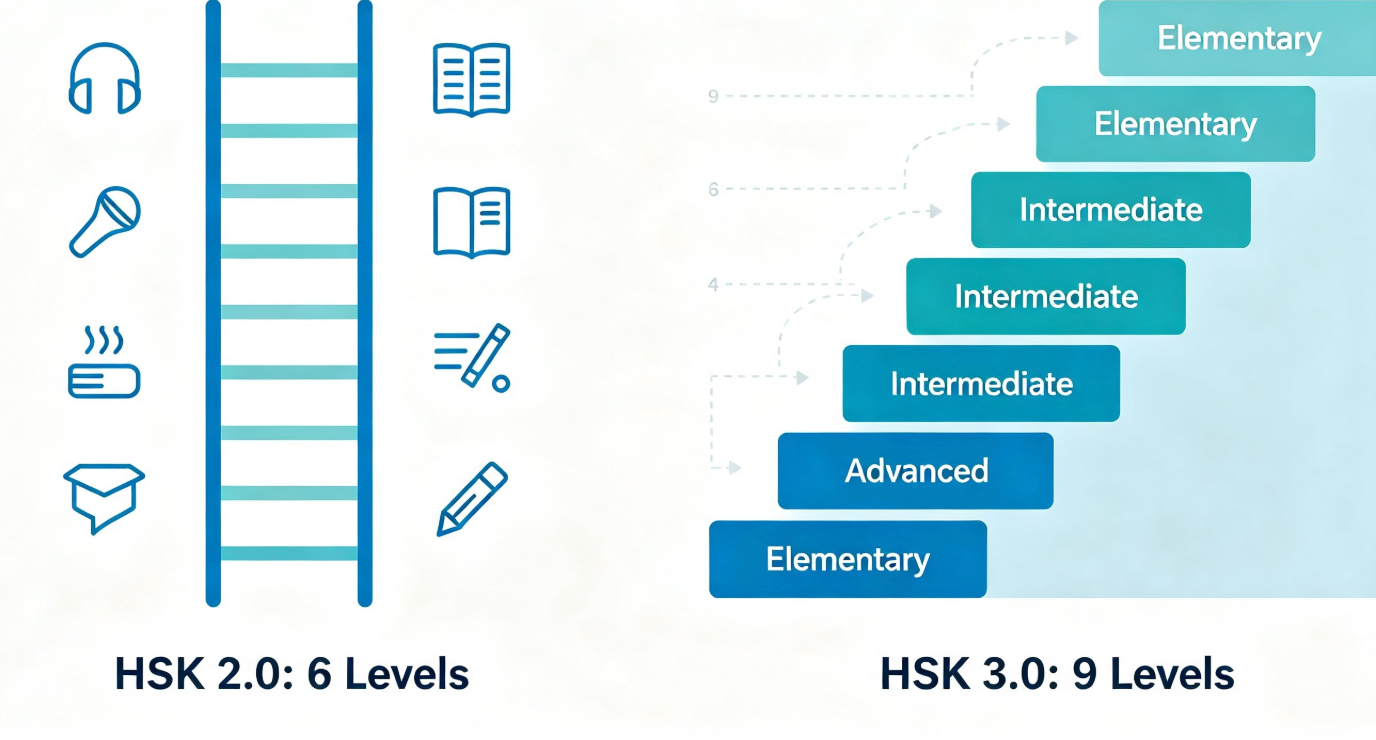
HSK 2.0 uses a six-level system:
HSK 1
HSK 2
HSK 3
HSK 4
HSK 5
HSK 6
In this system, HSK 1 is the most basic level, while HSK 6 represents advanced proficiency. For many universities in China, a score of HSK 4 or HSK 5 is often required for undergraduate programs, and HSK 5 or HSK 6 may be required for master’s programs, especially for humanities, social sciences, or Chinese-taught courses.
HSK 3.0
HSK 3.0 introduces a nine-level system, divided into three stages:
Elementary: HSK 3.0 Level 1, Level 2, Level 3
Intermediate: HSK 3.0 Level 4, Level 5, Level 6
Advanced: HSK 3.0 Level 7, Level 8, Level 9
This new structure provides a more detailed description of a student’s Chinese ability. Instead of only six large levels, HSK 3.0 can better show progress from beginner to advanced.
However, it is important to note that HSK 3.0 is still in the pilot phase and has not yet fully replaced HSK 2.0. Students should check with their local test center or the university they are applying to before choosing which version to take.
2. Question Types: More Integrated Skills in HSK 3.0
Another major change in HSK 3.0 is the design of question types.
HSK 2.0
HSK 2.0 is mainly divided into three parts:
Listening
Reading
Writing
For example, HSK 2.0 tests often include:
Multiple-choice listening questions
Reading comprehension passages
Fill-in-the-blank questions
Sentence writing
Short essays at higher levels
The advantage of HSK 2.0 is that its structure is familiar to many students, teachers, and universities. A large amount of preparation material is also available online.
HSK 3.0
HSK 3.0 places more emphasis on integrated language ability. This means the test does not only check whether students can recognize individual words or grammar points. It also tests whether they can use Chinese in realistic contexts.
Key features of HSK 3.0 include:
More authentic listening materials, such as real-life conversations, lectures, and daily communication
Reading texts that are closer to practical university and social life
Tasks that require both comprehension and production
A stronger focus on communication skills, especially at higher levels
For students, this means that memorizing vocabulary alone may not be enough. They also need to practice listening, reading, and using Chinese in context.
3. Vocabulary: From Separate Word Lists to Thematic Competence
Vocabulary is always one of the biggest concerns for HSK candidates.
HSK 2.0
HSK 2.0 has a clear word list for each level. For example:
HSK 1: Approximately 150 words
HSK 2: Approximately 300 words
HSK 3: Approximately 600 words
HSK 4: Approximately 1200 words
HSK 5: Approximately 2500 words
HSK 6: Approximately 5000 words
Many students prepare for HSK 2.0 by learning these word lists and practicing related grammar points. This method can be effective because the vocabulary requirement is clearly defined.
HSK 3.0
HSK 3.0 still has vocabulary requirements, but the approach is different. It focuses more on what students can do with language instead of only how many words they know.
For example, HSK 3.0 includes:
Thematic vocabulary
Contextual word use
Collocation awareness
Language competence in real situations
This change means that students should not only memorize isolated words. They should also learn how to use those words in sentences, conversations, reading passages, and academic contexts.
4. Test Duration: Longer and More Comprehensive at Higher Levels
Test duration is also an important practical difference.
HSK 2.0
HSK 2.0 test length depends on the level:
HSK 1: About 40 minutes
HSK 2: About 55 minutes
HSK 3: About 1 hour 15 minutes
HSK 4: About 1 hour 40 minutes
HSK 5: About 2 hours
HSK 6: About 2 hours 25 minutes
These durations do not usually include check-in time, ID verification, or test instructions. Students should arrive earlier than the official test time.
HSK 3.0
HSK 3.0 is generally longer and more comprehensive, especially at higher levels.
For example:
Elementary levels may last around 2 hours
Intermediate levels may last around 2.5 hours
Advanced levels may last up to 3 hours or more
The longer test time reflects the fact that HSK 3.0 assesses more integrated skills. Students need to maintain concentration for a longer period, especially in listening, reading, and writing tasks.
5. Should You Take HSK 2.0 or HSK 3.0?
This is the most practical question for international students.
The answer depends on three factors:
1. University Admission Requirements
Some universities may still accept HSK 2.0 scores. Others may begin to accept HSK 3.0 pilot scores. Before registering, you should check the official admission website of each university or contact the international student office.
2. Scholarship Requirements
If you are applying for scholarships such as the Chinese Government Scholarship, you should check the latest official language requirements. Scholarship rules may change, and incorrect information could affect your application.
3. Local Test Center Availability
HSK 3.0 is not yet available everywhere. Some test centers may still offer only HSK 2.0. Therefore, you should check which version is available in your area before preparing.
Final Recommendation
For students who are preparing now, the safest approach is:
If your university or scholarship clearly accepts HSK 2.0 scores, you can continue preparing for HSK 2.0.
If you want to prepare for the long term, you should also learn about HSK 3.0’s more communicative and integrated approach.
Always confirm the latest test version with official sources or local test centers.
HSK is not only a test for admission. It is also a preparation for living, studying, and communicating in China. The better you understand the differences between HSK 2.0 and HSK 3.0, the more accurately you can plan your study schedule.


