

3-Month HSK 3.0 Self-Study Schedule: Complete Revision Plan for Overseas Learners
 660
660 08/19/2026
Many overseas students prepare for the new HSK 3.0 pilot exam by self-study. Without teachers, offline courses, or local Chinese language environments, most learners face common problems: unbalanced skill training, random review, inefficient vocabulary memorization, and insufficient speaking practice.
Different from the old HSK 2.0 rote preparation method, HSK 3.0 focuses on integrated language ability, including listening flexibility, real-scene dialogue, logical writing, and mandatory oral tests. A disorganized study schedule will lead to low-efficiency learning and incomplete exam preparation.
This article provides a scientific, 3-month phase-based HSK 3.0 full revision plan, specially designed for overseas self-study candidates. It covers daily tasks, monthly goals, skill proportions, and final sprint strategies, suitable for all HSK 3.0 levels from elementary to intermediate.
Official Note: This study plan strictly follows the 2025–2026 HSK 3.0 official syllabus and pilot exam assessment standards.
Core Principles for HSK 3.0 Self-Study Planning
Before starting your 3-month preparation, follow these EEAT-aligned, exam-proven principles to ensure effective progress:
Balanced training: HSK 3.0 integrates listening, reading, writing, and speaking. No single skill can be neglected.
Progressive difficulty: Start with foundation consolidation, then move to skill improvement, and finish with mock sprint.
Daily output: Unlike HSK 2.0, HSK 3.0 requires continuous speaking and writing output.
Error accumulation review: Summarize mistakes weekly to avoid repeated scoring losses.
Month 1: Foundation Consolidation Stage (Days 1–30)
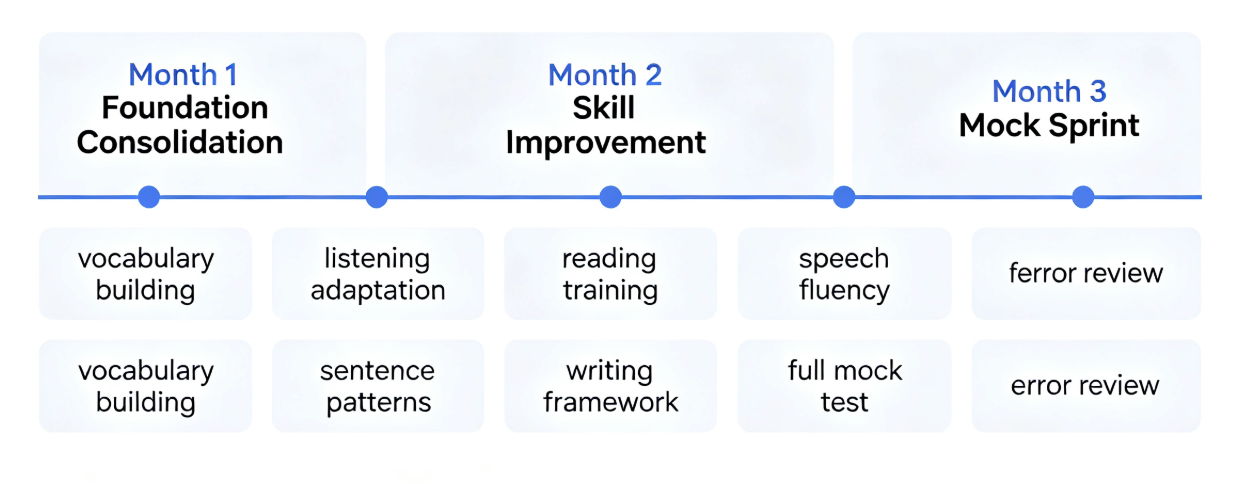
Core Goal: Build complete HSK 3.0 vocabulary foundation, adapt to new pronunciation speed, and master basic sentence structures.
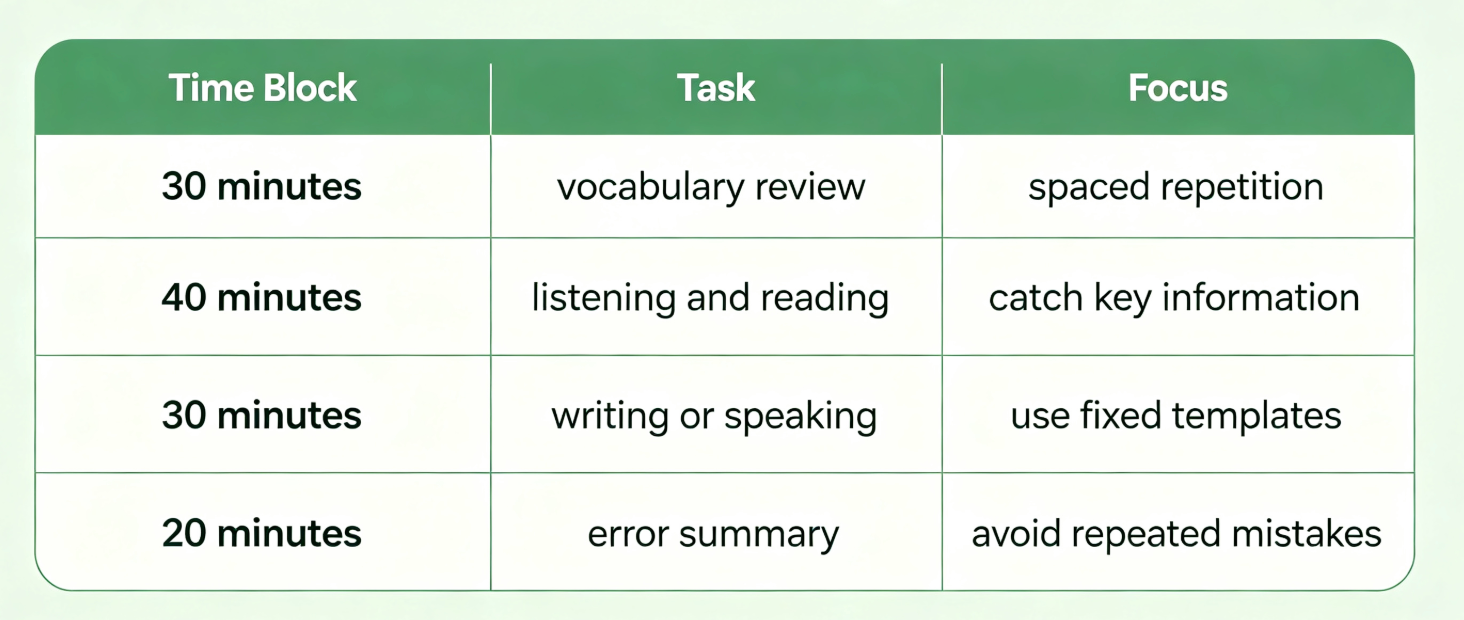
Daily Fixed Study Routine (1.5–2 hours per day)
Vocabulary (40%): Learn 10–20 new HSK 3.0 official words daily. Use spaced repetition review. Focus on modern conversational vocabulary newly added in HSK 3.0.
Listening Training (30%): Practice standard HSK 3.0 listening clips at normal speed. Adapt to natural tone changes, weak pronunciation, and real-scene dialogues.
Grammar & Sentence Pattern (20%): Master basic logical sentences commonly used in writing and speaking.
Oral Output (10%): Simple sentence imitation and pronunciation correction to adapt to HSK 3.0 speaking requirements.
Month 1 Key Achievements
Complete full basic vocabulary coverage, eliminate foundation blind spots, and get familiar with the question types and exam logic of the new HSK 3.0.
Month 2: Skill Improvement Stage (Days 31–60)
Core Goal: Improve listening sensitivity, reading speed, writing logic, and systematic speaking expression ability.
Daily Fixed Study Routine (2–2.5 hours per day)
Vocabulary Review (25%): Focus on high-frequency exam words and collocations. Eliminate unfamiliar vocabulary in listening and reading contexts.
Listening & Reading Training (40%): Complete targeted special question training. Summarize listening traps and reading logic rules of HSK 3.0.
Writing Practice (20%): Complete 1 short writing exercise every 2 days. Standardize paragraph structure, sentence logic, and punctuation format.
Speaking Training (15%): Use high-frequency topics and fixed templates to complete 1-minute oral output daily, improving fluency.
Month 2 Key Achievements
Form stable problem-solving habits, master standard writing and speaking frameworks, and significantly reduce basic error rates.
Month 3: Mock Sprint & Error Polishing Stage (Days 61–90)
Core Goal: Adapt to full exam rhythm, fix weak points, and stabilize overall scoring level.
Daily Fixed Study Routine (2.5 hours per day)
Full Mock Test (3 times per week): Simulate the complete HSK 3.0 exam process, including writing and mandatory speaking sections.
Error Sorting & Review (35%): Focus on wrong questions, unfamiliar vocabulary, listening blind spots, and speaking logic problems.
Writing & Speaking Polishing (35%): Optimize sentence diversity, replace simple expressions, and improve overall fluency and standardization.
Overall Knowledge Consolidation (30%): Quick review of full vocabulary and key grammar points to ensure no omissions.
Month 3 Key Achievements
Fully adapt to HSK 3.0 exam difficulty and rhythm, eliminate repetitive errors, and form a stable high-score answering system.
Weekly Fixed Self-Study Rule (Overseas Student Exclusive)
Monday–Friday: Daily fragmented fixed training, focus on skill accumulation
Saturday: Weekly small mock test + error summary
Sunday: Overall review and weak subject targeted make-up training
Common Self-Study Mistakes to Avoid in HSK 3.0 Preparation
Only memorizing vocabulary without output: HSK 3.0 values practical application; passive memorization cannot support speaking and writing scores.
Using outdated HSK 2.0 materials: Old resources cannot match the new vocabulary, speed, and integrated assessment rules.
Ignoring daily speaking practice: Mandatory oral test from Level 3 requires long-term fluency accumulation.
Irregular study rhythm: Cramming is ineffective for HSK 3.0’s comprehensive ability assessment.
Final 3-Month Preparation Suggestion
HSK 3.0 is an ability-oriented exam rather than a rote test. For overseas self-study students, a scientific phased schedule is more important than heavy learning intensity. By following this 3-month complete revision plan, you can steadily improve your listening, reading, writing, and speaking abilities, fully adapt to the new HSK 3.0 exam standards, and obtain qualified language scores for university admission and scholarship applications in China.


