

HSK 3.0 Speaking Preparation Strategy: Answer Templates & High-Frequency Topics
 967
967 08/17/2026
In the upgraded HSK 3.0 exam, speaking is no longer an optional section. Starting from Level 3, every candidate must complete a mandatory oral test, which greatly affects your overall HSK score and university application results.
Different from the old HSK 2.0 simple question-and-answer mode, HSK 3.0 speaking evaluates speech fluency, logical structure, vocabulary diversity, and real-scene expression ability. Most overseas students lose points due to unclear speaking logic, single sentence structures, and unfamiliar exam topics.
This article provides complete HSK 3.0 high-score speaking answer templates and summarizes all high-frequency exam topics, helping overseas learners quickly build a systematic speaking preparation system.
1. Core Scoring Standards of HSK 3.0 Speaking
To get a high score, you need to understand exactly how examiners grade your speaking performance:
Fluency: Stable speaking speed, few pauses and repetitions
Logical Structure: Clear beginning, main points and ending
Vocabulary & Grammar: Diversified sentence patterns and accurate word usage
Topic Completeness: Fully answer the question without digression
HSK 3.0 no longer rewards long, messy speeches. It values standardized structure and natural expression.
2. Universal High-Score Speaking Templates (All Topics Applicable)
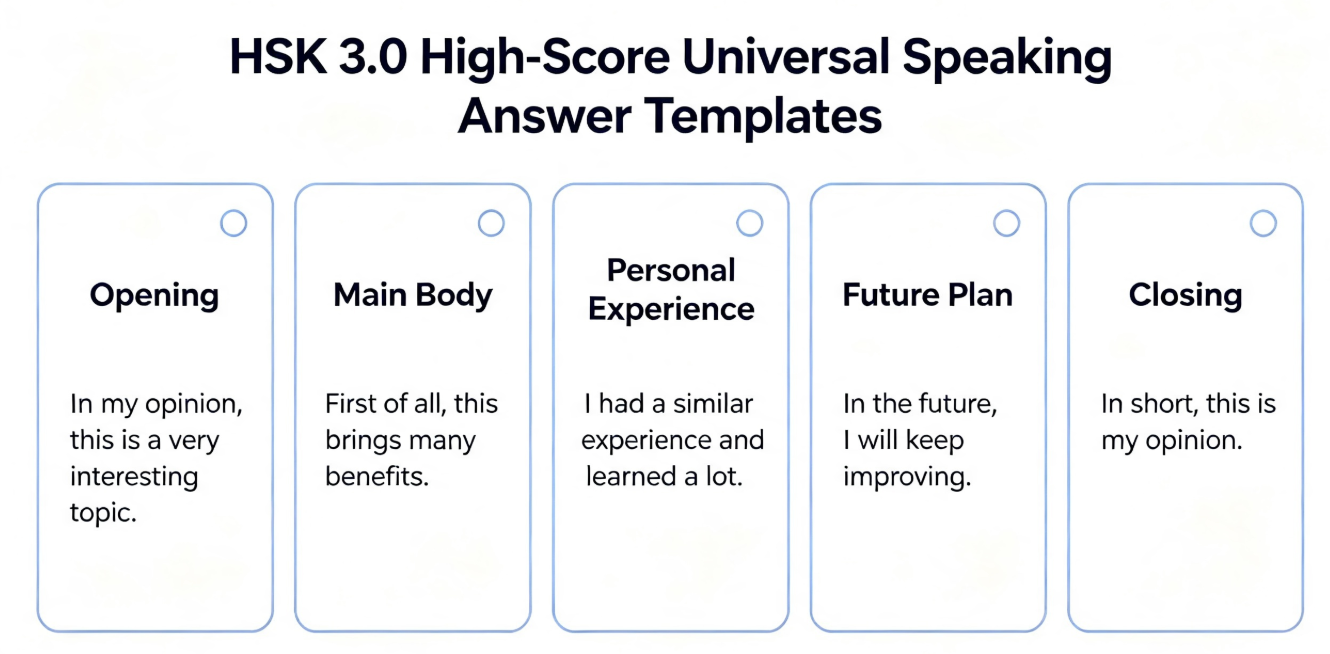
These fixed templates fit 90% of HSK 3.0 oral questions, including daily life, study, hobbies, opinions, plans and social topics. Overseas students can memorize and replace keywords freely.
2.1 Basic Opening Template
In my opinion, this is a very interesting and meaningful topic.
I have a lot of experience about this question, and I want to share my ideas.
Generally speaking, I think this topic is closely related to our daily life.
2.2 Main Body Expansion Template (Core Scoring Part)
First of all, this thing brings me many benefits in my study and life.
Secondly, it can help me improve my ability and enrich my experience.
In addition, it makes my daily life more colorful and meaningful.
2.3 Personal Experience Template
I usually keep this habit in my daily life.
Last time I had a similar experience, and I learned a lot from it.
For me, this is not only a simple habit, but also a good way to improve myself.
2.4 Future Plan Template
In the future, I will keep this good habit and make continuous progress.
I plan to spend more time on it to improve my overall ability.
I believe this change will bring me great help in my future study in China.
2.5 Standard Closing Template
In short, this is my opinion about this topic.
To sum up, I believe this habit is very valuable for every student.
3. HSK 3.0 High-Frequency Speaking Topics (Full Bank)
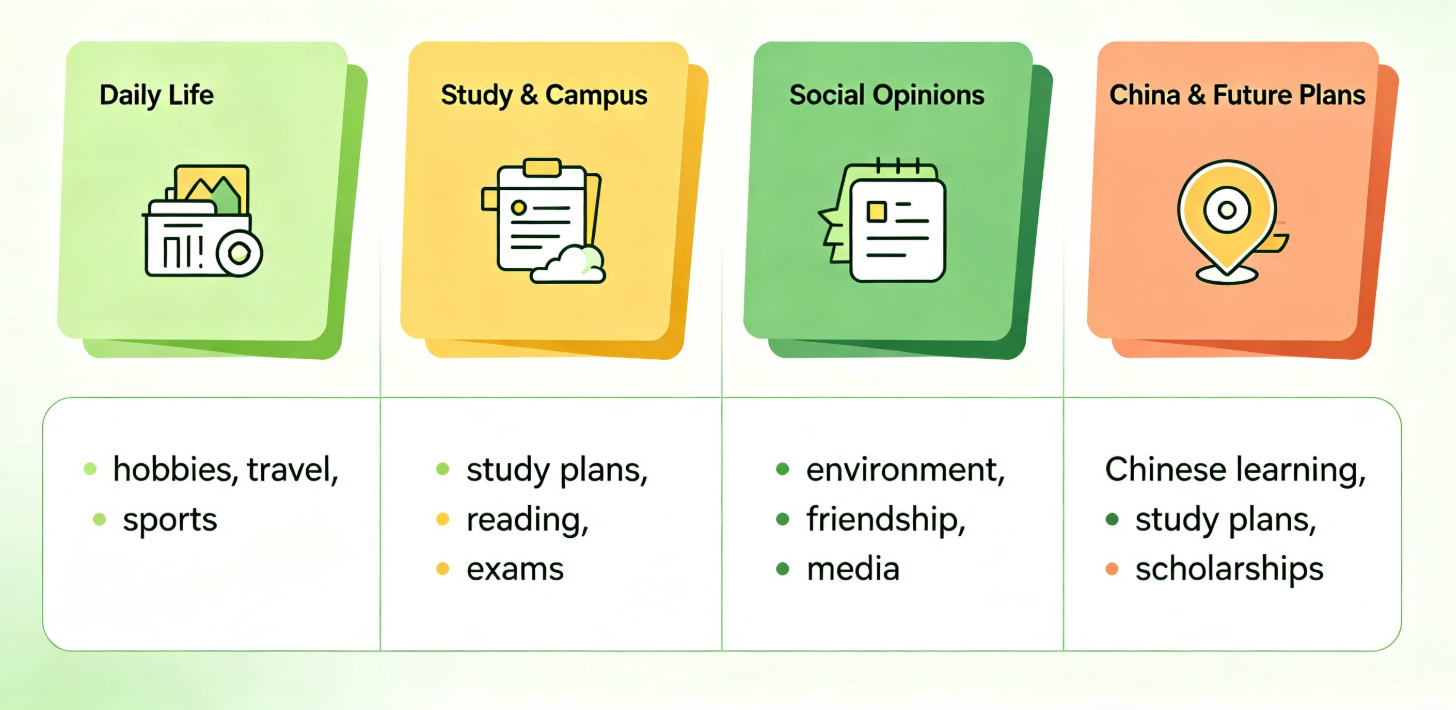
All topics below are summarized based on the latest HSK 3.0 pilot exams. Overseas students can focus on accumulating these categories to cover almost all exam questions.
3.1 Daily Life Topics (Most Frequently Tested)
Daily schedule, living habits, eating habits, sports, hobbies, travel, shopping, transportation, weather and seasonal life changes.
3.2 Study & Campus Topics
Chinese learning methods, study plans, favorite subjects, campus life, online study, time management, reading habits and exam preparation experience.
3.3 Social & Opinion Topics
Mobile phone usage, social media, environmental protection, healthy lifestyle, friendship, family relationship, cultural differences and good personal qualities.
3.4 Future Plan & China Study Topics
Reasons for learning Chinese, future study plans, expectations for studying in China, personal improvement goals and career plans.
4. Scientific Accumulation Method for Overseas Students
Without a local Chinese environment, overseas learners need efficient targeted training methods:
4.1 One topic per day fixed output
Choose one high-frequency topic every day, use the fixed templates above, and complete a 60–90 seconds oral speech. Stable daily output is the fastest way to adapt to HSK 3.0 speaking rhythm.
4.2 Replace keywords to realize universal adaptation
Do not memorize rigid scripts. Master the logical framework, and replace only topic-related keywords. One set of templates can adapt to hundreds of different questions.
4.3 Simulate real exam speed
HSK 3.0 requires natural speaking speed. Avoid too slow and hesitant pronunciation. Record your own voice and check for pauses, repetition and tone problems.
4.4 Accumulate exclusive topic vocabulary
Classify and store professional vocabulary for life, study, sports and society. Rich topic vocabulary is the key to distinguish high-score candidates from average candidates.
5. Common HSK 3.0 Speaking Mistakes to Avoid
Single sentence structure: Overusing simple sentences leads to low comprehensive scores
Long pause and self-correction: Frequently repeating and modifying sentences reduces fluency scores
Off-topic content: Talking about irrelevant content to prolong speaking time
Fixed rigid old HSK 2.0 thinking: Too simple answer cannot meet HSK 3.0’s logical requirements
Unstable tone and unclear pronunciation: Affects examiner’s overall evaluation
Final Speaking Strategy Summary
HSK 3.0 speaking high scores do not rely on talent or difficult vocabulary. They depend on fixed logical templates, sufficient topic accumulation and stable speaking habits. Overseas students can quickly improve their oral performance through systematic daily training, fully meeting the language requirements for Chinese university admission and scholarships.


