

Is HSK a Good Roadmap for Learning Chinese?
 437
437 08/19/2026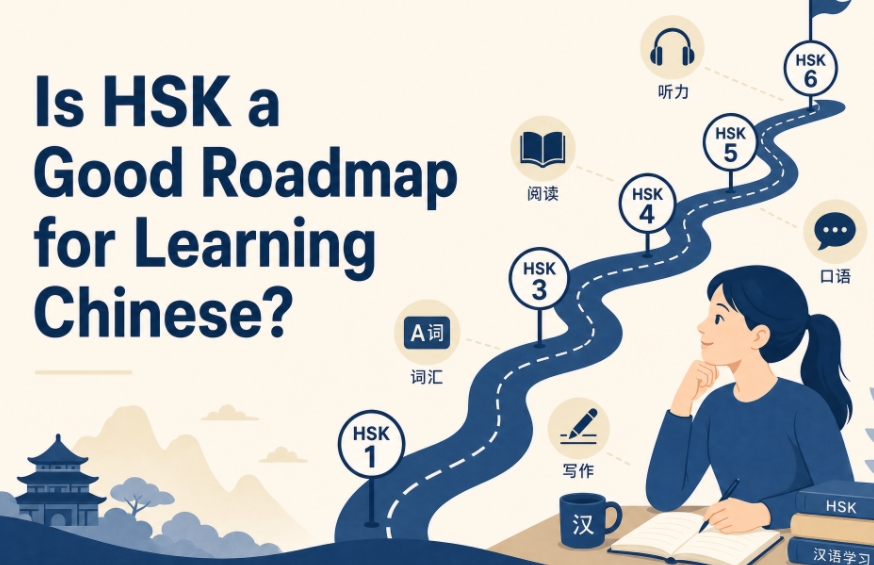
Yes, HSK can be a good roadmap for learning Chinese because it divides Chinese proficiency into progressive levels and gives learners clear goals for vocabulary, grammar, listening, reading, writing and communication.
However, HSK should be used as the structure of your learning plan—not as the entire plan.
If you only memorise HSK vocabulary and complete practice questions, you may pass a test without becoming confident in real conversations. A complete HSK learning roadmap should combine:
Structured courses
Vocabulary and grammar practice
Listening and reading training
Speaking and writing feedback
Regular AI assessments
Targeted question-bank practice
Full HSK mock exams
Progress reviews and study-plan adjustments
This is where an integrated platform can be especially useful. HSKTest.ai combines HSK courses, a level-based question bank, AI assessment, speaking and writing feedback, targeted practice and realistic mock exams. Instead of using a different resource for every problem, learners can follow one connected path from learning new content to testing and improving it.
Read the complete guide and use the related free tool on hsktest.ai.
What Does It Mean to Use HSK as a Learning Roadmap?
Using HSK as a roadmap means organising your Chinese studies around progressive proficiency levels.
Rather than asking, “What should I learn next?”, you follow a clearer sequence:
Learn the foundations → Build level-appropriate vocabulary and grammar → Practise the core skills → Check your level → Fix your weaknesses → Move to the next stage
For example, a complete beginner might begin with pronunciation, Pinyin, tones, greetings and simple sentence patterns. As the learner progresses, the focus gradually expands to longer conversations, more complex reading, structured writing and advanced communication.
An HSK roadmap can help answer several common questions:
Which words should I learn?
Which grammar points should I study?
What should I be able to understand at my level?
When should I move to the next stage?
How can I check whether I am improving?
Which skills are holding me back?
Am I ready to take the HSK test?
Without a structured system, beginners often jump between random videos, apps, word lists and textbooks. They may study a lot but still have no clear picture of their current level or next goal.
HSK provides the structure needed to solve this problem.
Why HSK Is a Useful Chinese-Learning Roadmap
1. HSK gives learners clear stages
“Learn Chinese” is an extremely broad goal. It does not tell you what to study today or what you should achieve this month.
An HSK level provides a more specific target.
Instead of saying:
I want to improve my Chinese.
You can say:
I want to complete the beginner-level vocabulary and grammar, understand short conversations, read simple passages and prepare for an HSK-level assessment.
This makes it easier to create weekly tasks and measure progress.
If you are unsure which level matches your current ability, an HSK assessment on HSKTest.ai can help you identify your starting point. The result can then be used to choose suitable courses and practice instead of beginning with material that is too easy or too difficult.
2. HSK creates a logical order for vocabulary
One of the biggest problems for independent learners is deciding which Chinese words to learn first.
A random vocabulary list may include words that are common but not suitable for your current stage. You may also learn hundreds of isolated words without knowing how to use them in a sentence.
An HSK-based roadmap organises vocabulary by level and allows you to progress from basic daily expressions to more advanced topics.
A better vocabulary cycle is:
Learn a group of level-appropriate words.
Listen to their pronunciation.
Study them inside sentences.
Practise recognising and using them.
Review forgotten words.
Test them again in a new context.
Learners can use the HSKTest.ai question bank and practice tools to review vocabulary through flashcards, fill-in-the-blank questions, dictation, sentence ordering and other active exercises.
This turns vocabulary learning into a complete process rather than a one-time memorisation task.
3. HSK provides a grammar sequence
Chinese grammar can feel confusing when it is studied without an order. A beginner may encounter advanced structures before mastering basic sentence patterns.
An HSK learning path helps learners study grammar progressively.
Beginners can first focus on structures such as:
Basic word order
Questions with 吗
Possession with 的
Sentences using 是
Sentences using 有
Location with 在
Numbers and measure words
Time expressions
Basic negative forms
Common question words
Later stages can introduce comparisons, complements, longer sentences, more complex aspect markers and formal written structures.
When a grammar point is difficult, reading another explanation is not always enough. Learners need to recognise it, complete sentences with it and use it in their own communication.
HSKTest.ai combines structured learning with level-based exercises, allowing a learner to study a grammar point in a course and then practise it through the question bank.
4. HSK makes progress measurable
Many Chinese learners study for several months but cannot answer a simple question:
Am I actually improving?
Time spent studying does not always equal progress. Completing lessons also does not guarantee that the knowledge can be used.
An HSK roadmap provides measurable checkpoints:
Vocabulary recognised
Grammar points understood
Listening questions answered
Reading passages completed
Speaking tasks performed
Written responses produced
Practice accuracy improved
Mock-exam results increased
HSKTest.ai uses assessment and practice results to help learners identify strengths and weaknesses. Instead of relying only on how confident you feel, you can use actual performance to decide what to study next.
Where an HSK-Only Approach Can Fail
HSK is useful, but it is not automatically a complete Chinese course.
Problem 1: Memorising vocabulary without using it
A learner may recognise hundreds of HSK words but still struggle to create a simple sentence.
The problem is not necessarily vocabulary size. It is the lack of active use.
The solution is to learn vocabulary through a complete cycle:
Learn → Recognise → Listen → Use → Review
On HSKTest.ai, learners can study vocabulary in level-based courses and then apply it through flashcards, listening exercises, sentence ordering, speaking tasks and question-bank practice.
This helps turn passive vocabulary into usable Chinese.
Problem 2: Passing reading exercises but struggling with conversations
Some learners focus heavily on vocabulary and reading because these areas are easier to practise independently. When they hear natural Chinese, however, they cannot recognise the same words.
Listening must be trained separately.
A useful listening routine includes:
Listening without looking at the text
Identifying familiar words
Reading the transcript
Listening again
Repeating the recording
Checking understanding through questions
HSKTest.ai includes listening exercises and HSK-style practice that allow learners to move from lesson content to active listening and assessment.
Problem 3: Knowing the answer but being unable to speak
Multiple-choice questions test recognition. Speaking requires the learner to produce Chinese without seeing the answer first.
To build speaking ability, learners should:
Repeat model sentences
Answer simple questions aloud
Describe pictures
Retell short passages
Record their own voice
Review pronunciation and fluency problems
Repeat the task after receiving feedback
HSKTest.ai provides AI-supported speaking assessment and feedback. This is especially useful for independent learners who do not always have a teacher or language partner available.
Instead of simply telling you to “practise speaking more,” the platform helps identify the areas that need improvement.
Problem 4: Avoiding Chinese writing
Writing is often neglected because learners do not know whether their sentences are correct.
They may understand a grammar rule but still use the wrong word order, vocabulary or expression when writing independently.
A better writing process is:
Study a model sentence or passage.
Write a short response.
Receive feedback.
Correct the errors.
Rewrite the response.
apply the corrected structure in a new topic.
HSKTest.ai includes writing practice and AI-assisted feedback, helping learners identify grammar, vocabulary and expression problems without waiting for manual corrections.
Problem 5: Taking tests without analysing mistakes
Completing many questions does not guarantee improvement. If you repeatedly make the same mistake without understanding it, more practice may only reinforce the problem.
After every exercise or test, ask:
Was the problem vocabulary?
Did I misunderstand the grammar?
Could I not recognise the word in audio?
Did I read too slowly?
Did I misunderstand the question?
Was my answer incomplete?
Was I careless under time pressure?
HSKTest.ai can connect assessment results with targeted practice. Learners can use AI analysis to locate weak areas and return to suitable courses or question-bank exercises.
This creates a learning loop:
Assessment → Weakness analysis → Targeted learning → Focused practice → Reassessment
HSK Is a Framework, Not Just an Exam
A common mistake is to think that HSK study should begin only when you have registered for the exam.
In reality, HSK can be used much earlier as a framework for organising Chinese learning.
You can follow an HSK roadmap even if:
You do not yet have a test date
You are learning Chinese for personal interest
You want to travel in China
You need Chinese for work
You plan to study in China later
You want a structured independent-learning plan
You are not sure whether you will take the exam
The exam provides a measurable target, but the learning process should still develop practical Chinese ability.
The ideal goal is not:
I memorised all the words on a list.
It is:
I can understand and use the vocabulary, grammar and communication skills expected at this stage.
Who Should Use HSK as a Learning Roadmap?
Complete beginners
HSK gives beginners a clear starting point and prevents them from studying advanced or irrelevant material too early.
A beginner can use HSKTest.ai to start with level-based courses, foundational vocabulary, basic grammar and guided exercises.
Self-study learners
Independent learners often lack feedback and do not know whether they are following the correct sequence.
With courses, a question bank, AI assessment and mock exams in one platform, HSKTest.ai can provide the structure normally supplied by a teacher or formal programme.
Learners preparing to study in China
Students who plan to apply to a Chinese university may need to demonstrate an appropriate level of Chinese proficiency, depending on the programme and its requirements.
An HSK roadmap makes it easier to connect long-term goals with current learning tasks. HSKTest.ai also brings Chinese learning, HSK preparation and study-in-China planning into the same platform.
Learners with an upcoming HSK test
Test candidates need more than general Chinese lessons. They must also understand question types, timing and exam procedures.
The HSK mock exams on HSKTest.ai recreate an HSK-style testing process and provide results and analysis. Learners can use these results to identify weak sections before the real test.
Learners who feel stuck
Some learners study for months without seeing clear improvement. The problem may not be effort; it may be that their practice does not match their weaknesses.
AI assessment can help determine whether the main obstacle is vocabulary, grammar, listening, reading, speaking, writing or test technique. The learner can then complete targeted courses and question-bank exercises instead of restarting everything.
A Complete HSK Learning Roadmap
A good roadmap should include six connected stages.
Stage 1: Find your starting level
Do not choose a level based only on how long you have studied Chinese.
Someone who has studied casually for two years may have strong vocabulary but weak listening. Another learner may speak confidently but struggle to read characters.
Use an assessment to establish a baseline. Record your results for each skill rather than focusing only on the overall score.
HSKTest.ai provides level assessment and AI analysis that can help learners choose an appropriate starting point.
Stage 2: Build knowledge through structured courses
Once you know your level, follow a course that covers the vocabulary, grammar and communication skills required at that stage.
Do not study only your favourite skill. Your course plan should include:
Vocabulary
Grammar
Listening
Reading
Speaking
Writing
Cultural context where appropriate
The structured HSK learning modules on HSKTest.ai allow learners to follow level-based content rather than gathering unrelated lessons from multiple websites.
Stage 3: Use the question bank for active practice
Learning a rule and applying it are different skills.
After each course unit, use exercises to check whether you can recognise and use what you learned.
For example:
Use flashcards for vocabulary recall.
Use fill-in-the-blank exercises for grammar.
Use sentence ordering for Chinese word order.
Use dictation for sound-to-character recognition.
Use reading questions for comprehension.
Use speaking tasks for active production.
Use writing exercises for expression.
HSKTest.ai provides multiple exercise formats within its practice system, allowing learners to move directly from a lesson to relevant practice.
Stage 4: Use AI assessment to identify weaknesses
Do not wait until the end of an entire level to check your progress.
Complete short assessments regularly and compare your results. AI analysis can help reveal patterns that may not be obvious from a single score.
For example:
Low listening accuracy may indicate weak sound recognition.
Slow reading may indicate insufficient character fluency.
Speaking errors may come from tones, pronunciation or grammar.
Writing problems may come from word order or limited vocabulary.
Repeated mistakes in one question type may indicate a strategy problem.
HSKTest.ai can assess performance and direct learners towards the areas requiring more work.
Stage 5: Complete targeted improvement
Once a weakness has been identified, do not continue with random practice.
Use a focused improvement cycle:
Review the relevant course.
Study the specific vocabulary or grammar.
Complete targeted questions.
Use the skill in speaking or writing.
Reassess the same area.
This is more efficient than repeating an entire level every time one skill falls behind.
Because HSKTest.ai combines courses, a question bank and AI analysis, learners can complete this improvement cycle without switching between unrelated resources.
Stage 6: Take a full mock exam
A learner may perform well in short exercises but struggle during a complete timed test.
A full mock exam checks:
Stamina
Time management
Familiarity with question types
Listening concentration
Reading speed
Writing performance
Ability to work under pressure
After completing a mock exam on HSKTest.ai, use the detailed analysis to create a final improvement plan. Review weak sections, complete targeted practice and take another mock exam to check whether your performance has improved.
How to Build a Weekly HSK Study Plan
A balanced weekly plan should include learning, practice, application and assessment.
Monday: Learn new content
Study a level-appropriate course covering new vocabulary and grammar.
Tuesday: Vocabulary and grammar practice
Use the question bank to practise the material introduced on Monday.
Wednesday: Listening and speaking
Complete listening exercises, repeat the recordings and use AI speaking assessment to check pronunciation and fluency.
Thursday: Reading and writing
Read a level-appropriate passage and complete a short writing task. Use AI feedback to identify and correct errors.
Friday: Mixed practice
Complete exercises covering several skills and review mistakes from the week.
Saturday: Assessment or mock-test section
Take a short assessment or practise one section of an HSK mock exam.
Sunday: Review and adjust
Review your results and decide what should receive more attention during the following week.
This schedule prevents a common problem: spending every day memorising vocabulary while ignoring speaking, writing and assessment.
How to Know When You Are Ready for the Next HSK Level
Do not move to the next level only because you have finished a textbook or memorised a vocabulary list.
You are more likely to be ready when you can:
Recognise most level-appropriate vocabulary in context
Understand the main ideas of suitable listening materials
Read passages without translating every word
Use important grammar patterns correctly
Speak about familiar topics
Complete appropriate writing tasks
Perform consistently in practice
Complete a mock exam within the required conditions
Explain and correct your common mistakes
A single good score is encouraging, but consistent performance is more reliable.
Use multiple practice sessions and mock exams on HSKTest.ai to confirm that your results are stable before moving to a higher level.
Can HSK Make You Fluent in Chinese?
HSK can support fluency, but passing an HSK test does not automatically make someone fluent.
Fluency also requires:
Regular real-world listening
Spontaneous speaking
Interaction with different speakers
Understanding natural expressions
Reading outside test materials
Writing for practical purposes
Cultural and contextual knowledge
HSK gives you a strong structure for developing these abilities, but you must actively use the language.
A useful principle is:
Use HSK to decide what to learn, and use real communication to make that knowledge practical.
Courses and question banks build knowledge. AI speaking and writing tools help you produce Chinese. Mock exams measure performance. Real conversations, reading and media exposure then expand your ability beyond the test.
Why a One-Stop HSK Platform Is More Efficient
Chinese learners often use one app for vocabulary, another for grammar, a different website for mock exams and a general AI tool for writing corrections.
This creates several problems:
Progress is stored in different places.
Learning materials may follow different standards.
Exercises may not match the current course.
General feedback may not reflect HSK expectations.
Learners cannot easily connect test results with the next lesson.
Too much time is spent choosing resources.
HSKTest.ai is designed to connect the full learning process:
Do not know where to start? Use the level assessment.
Need structured knowledge? Follow the HSK courses.
Cannot remember vocabulary? Use flashcards and question-bank practice.
Grammar remains unclear? Return to level-based lessons and targeted exercises.
Listening is weak? Complete listening and dictation training.
Not confident speaking? Use AI speaking assessment and feedback.
Writing contains frequent errors? Use AI writing analysis and correction.
Do not know your weak areas? Review AI performance analysis.
Preparing for the real exam? Complete realistic HSK mock tests.
Progress has stopped? Use assessment results to generate a more focused study path.
This is what turns HSK from a list of levels into a complete learning roadmap.
Common Mistakes When Following an HSK Roadmap
Studying only vocabulary lists
Vocabulary is important, but words must be connected with pronunciation, sentences, listening and communication.
Completing exercises without reviewing errors
Every mistake should lead to a specific review task. Use analysis results to decide which course or practice area to revisit.
Ignoring speaking and writing
Recognition exercises are not enough. Include activities that require you to produce original Chinese.
Taking mock exams too early
A mock exam is a measurement tool, not a substitute for learning. Study the necessary content before repeatedly taking full tests.
Taking mock exams without follow-up practice
A score alone does not improve your Chinese. Analyse the result and complete targeted exercises before trying again.
Advancing too quickly
Finishing a level does not always mean mastering it. Check performance across multiple skills before moving forward.
Using too many unrelated resources
Choose one main learning system and use supplementary materials only when they solve a specific problem.
Frequently Asked Questions
Is HSK suitable for complete beginners?
Yes. HSK provides a progressive structure that can help complete beginners organise vocabulary, grammar and communication skills. Beginners should also study Pinyin and tones as part of their foundational learning.
Can I use HSK to learn Chinese without taking the exam?
Yes. You can use HSK levels to organise your learning even if you do not plan to register for an exam. The levels provide milestones and make progress easier to measure.
Should I learn Chinese first and prepare for HSK later?
General Chinese learning and HSK preparation do not have to be completely separate. A good HSK course can help you develop practical Chinese while gradually preparing for the exam format.
Is an HSK vocabulary list enough?
No. Vocabulary lists provide useful content, but you also need grammar, listening, reading, speaking, writing and active practice.
HSKTest.ai connects vocabulary learning with courses, exercises, AI feedback and assessments so that words are learned and used in context.
How do I choose the correct HSK level?
Use a level assessment instead of choosing only according to study time. Your vocabulary, listening, reading, speaking and writing abilities may be at different stages.
How often should I take an HSK mock exam?
Beginners should first build enough level-appropriate knowledge to benefit from the result. During focused test preparation, regular mock exams can be used to measure improvement, provided each test is followed by analysis and targeted practice.
Can AI help with HSK preparation?
AI can help identify weak areas, assess speaking and writing, analyse performance and suggest more focused practice. It works best when combined with structured courses and level-appropriate exercises.
What is the best way to use HSKTest.ai?
Start with an assessment, choose suitable courses, practise through the question bank, use AI speaking and writing feedback, review your weak areas and complete a mock exam. Then use the results to begin the next improvement cycle.
Final Verdict: Is HSK a Good Roadmap?
HSK is a good roadmap for learning Chinese, but it works best when it is treated as a complete learning framework rather than only an exam syllabus.
Use HSK levels to decide:
What to learn
Which skills to develop
What to practise
When to assess progress
Which weaknesses to correct
When to move forward
The strongest learning cycle is:
Assess → Learn → Practise → Receive feedback → Fix weaknesses → Take a mock exam → Reassess
HSKTest.ai supports every stage of this cycle with level assessment, structured HSK courses, a targeted question bank, AI speaking and writing feedback, performance analysis and realistic mock exams.
Instead of combining multiple disconnected resources, learners can use one platform to diagnose problems, learn the required knowledge, practise individual skills and measure improvement.
Start with a free assessment or learning module on HSKTest.ai, identify your current level and turn the HSK system into a practical roadmap for improving your Chinese.


