

HSK 3.0 Vocabulary Requirements Level 1–9: Word Scope & Effective Memorization Plans
 706
706 08/17/2026
If you plan to take the new HSK 3.0 pilot examination for university admission or scholarship applications in China, setting clear vocabulary targets is the foundation of your whole learning schedule.
HSK 3.0 launched the nine-level system divided into Elementary, Intermediate and Advanced tiers. Compared with the old HSK 2.0, it updates vocabulary standards, adds modern daily expressions, and requires active language application instead of simple word recognition.
Important Note: HSK 2.0 regular examinations are still available globally during the transition period. This article focuses exclusively on the official vocabulary standards of the latest HSK 3.0 pilot exam. Confirm whether your local test center offers HSK 3.0 and whether target universities accept HSK 3.0 transcripts before registration.
1. Official Cumulative Vocabulary Standard for HSK 3.0 (Level 1–9)
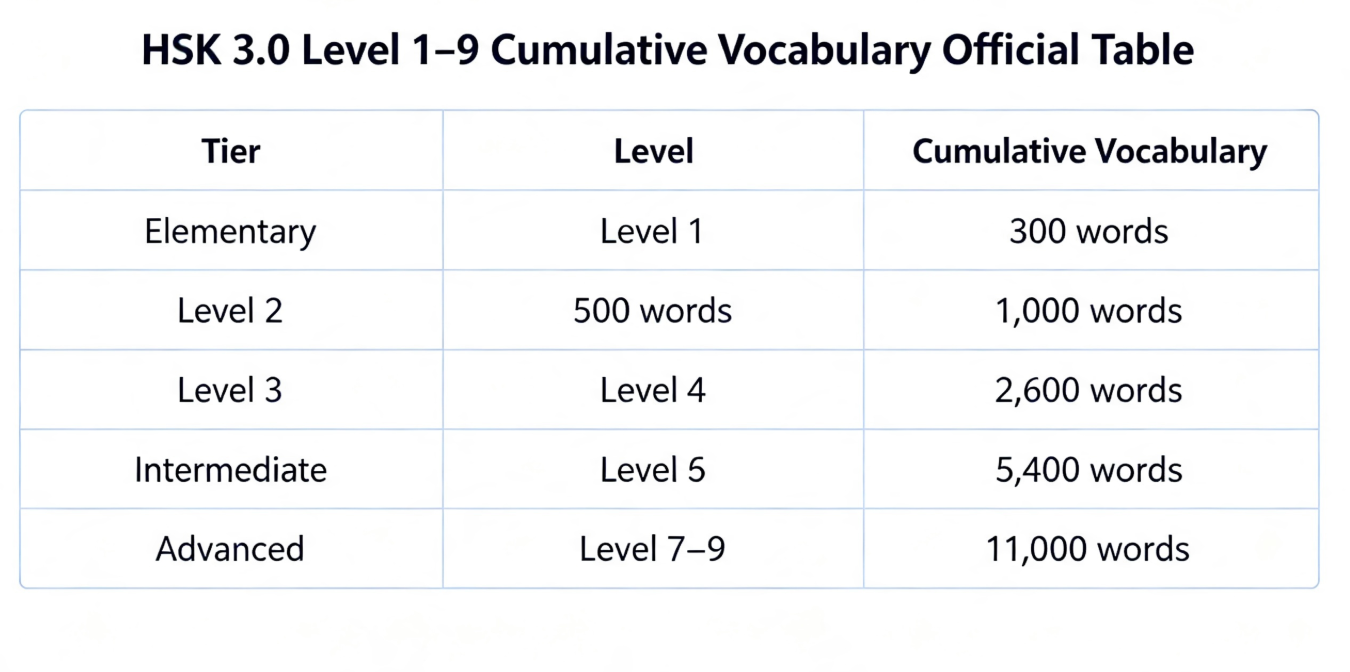
All figures below refer to cumulative vocabulary required to reach each level, following the 2025 official syllabus released by the Center for Language Education and Cooperation.
Elementary Tier
HSK 3.0 Level 1: 300 words
Basic survival vocabulary for greetings, self-introduction, numbers and simple daily communication.
HSK 3.0 Level 2: 500 words
Handle simple conversations about shopping, transportation, time and daily arrangements.
HSK 3.0 Level 3: 1,000 words
Communicate smoothly in daily study, travel and routine life scenarios. Starting from Level 3, the written exam must be taken together with mandatory oral assessment.
Intermediate Tier
HSK 3.0 Level 4: 2,000 words
Suitable for undergraduate Chinese-taught program applicants. Learners can discuss social, academic and general work topics.
HSK 3.0 Level 5: 3,600 words
Common benchmark for master’s admission and Chinese Government Scholarship candidates. You can read news articles and express complete personal opinions.
HSK 3.0 Level 6: 5,400 words
Upper-intermediate proficiency, supporting independent study in most academic fields in China.
Advanced Tier
HSK 3.0 Level 7–9: 11,000 words (shared advanced band)
Designed for academic research, professional communication and advanced Chinese learning. This tier covers formal written vocabulary, idioms, literary expressions and discipline-general academic terms.
2. Vocabulary Scope & Practical Competence by Tier
Elementary Tier (HSK 3.0 Level 1–3)
Core vocabulary: Daily survival language, nouns, basic verbs, adjectives and simple conjunctions.
Learning focus: Recognize Chinese characters, match words with meanings, build listening sensitivity and practice simple oral output.
Key difference from old standards: Higher vocabulary requirements at the beginner stage, more practical daily phrases.
Intermediate Tier (HSK 3.0 Level 4–6)
Core vocabulary: Study, hobbies, social discussion, comparison and logical expression. A large number of verb collocations and contextual phrases are added.
Learning focus: Distinguish similar vocabulary; master how to use words in listening, reading, writing and speaking. Pure passive word memorization cannot meet the integrated test requirements of HSK 3.0.
Advanced Tier (HSK 3.0 Level 7–9)
Core vocabulary: Abstract nouns, formal written language, Chinese idioms, academic expressions.
Learning focus: Grasp subtle semantic differences between synonyms, understand implicit meaning in long texts and academic materials.
3. HSK 3.0 Targeted Vocabulary Memorization Plans
HSK 3.0 attaches great importance to active word usage. Traditional rote memorization of word lists alone will lead to low scores in integrated listening, speaking and reading sections. Below are proven strategies for overseas self-learners.
Universal Core Learning Rules
Learn vocabulary within complete sentences
Do not only memorize Chinese-English translation pairs. Always learn at least one authentic sample sentence for each new word, to master collocation and usage context.
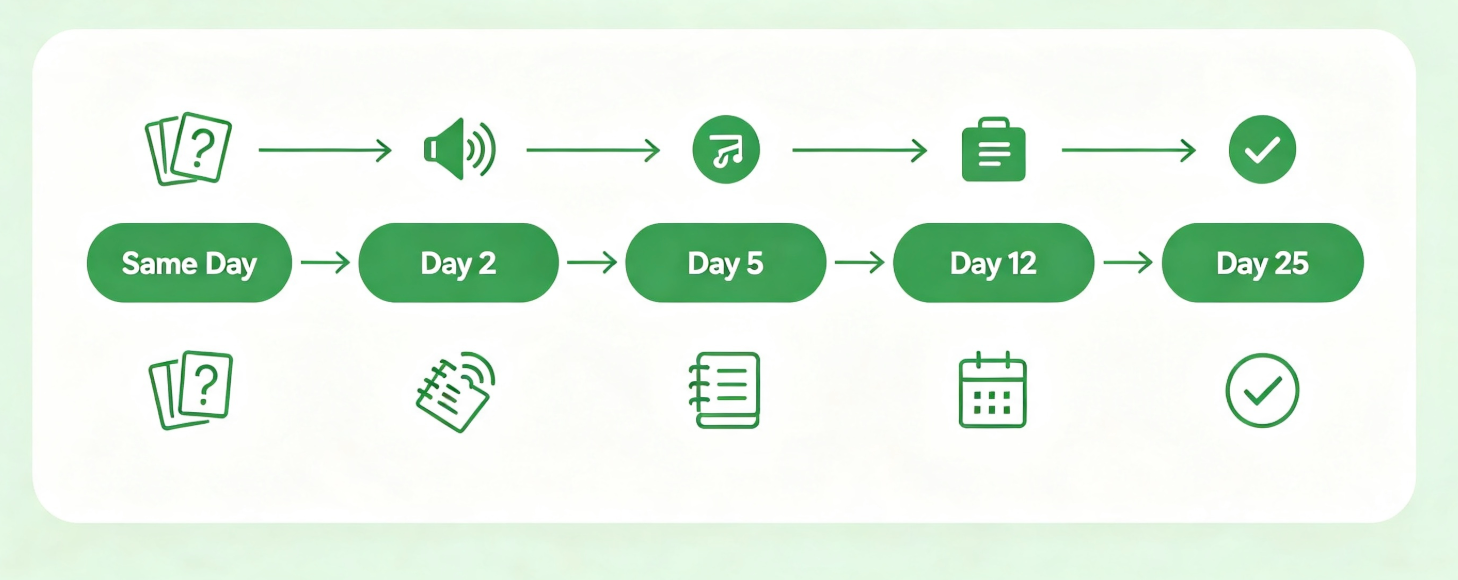
Adopt spaced repetition to reduce forgetting
Recommended review cycle: New words on the same day → review on day 2 → review on day 5 → review on day 12 → consolidation on day 25. Flashcard tools supporting spaced repetition are highly recommended.
Prioritize high-frequency vocabulary
Allocate more study time to frequently tested words related to campus life, social topics and study scenarios. Low-frequency vocabulary only requires basic recognition.
Level-Based Daily Vocabulary Schedule
HSK 3.0 Level 1–3: 10–15 new words per day
HSK 3.0 Level 4–6: 18–28 new words per day
HSK 3.0 Level 7–9: 20–30 new words per day
Consistent daily practice is far more effective than intensive last-minute cramming.
Special Reminder for HSK 3.0 Candidates
Since Level 3 requires compulsory oral examination, you need to consciously practice constructing oral sentences with newly learned vocabulary. You cannot only focus on reading and recognition like many HSK 2.0 learners.
4. Common Vocabulary Learning Mistakes for HSK 3.0
Preparing for HSK 3.0 only using outdated HSK 2.0 vocabulary resources. Many newly added modern expressions will be missing.
Ignoring oral practice while memorizing vocabulary. The integrated speaking test will expose insufficient active word storage.
Skipping elementary vocabulary and jumping directly to intermediate levels. Weak foundation causes continuous misunderstanding in listening materials.
Only memorizing Pinyin without learning Chinese characters. Homophones with different characters easily create confusion during examinations.
Stopping regular vocabulary review after finishing the official word list. Continuous revision is required until your exam date.
5. Match Vocabulary Goals With Your China Admission Plan
Undergraduate applicants (Chinese-taught courses): Target HSK 3.0 Level 4 (2,000 cumulative words)
Master & scholarship applicants: Target HSK 3.0 Level 5 or Level 6
Academic research, literature and advanced professional programs: Prepare toward the advanced HSK 7–9 band
Final Advice
Vocabulary building is a long-term project. Confirm whether you are eligible to sign up for HSK 3.0 pilot tests first, set your target level, and maintain stable daily learning rhythm. Combine vocabulary training with official HSK 3.0 mock exercises to improve comprehensive test performance.


