
I Have HSK 4: Which Study Options in China Are Open to Me?
 362
362 10/08/2026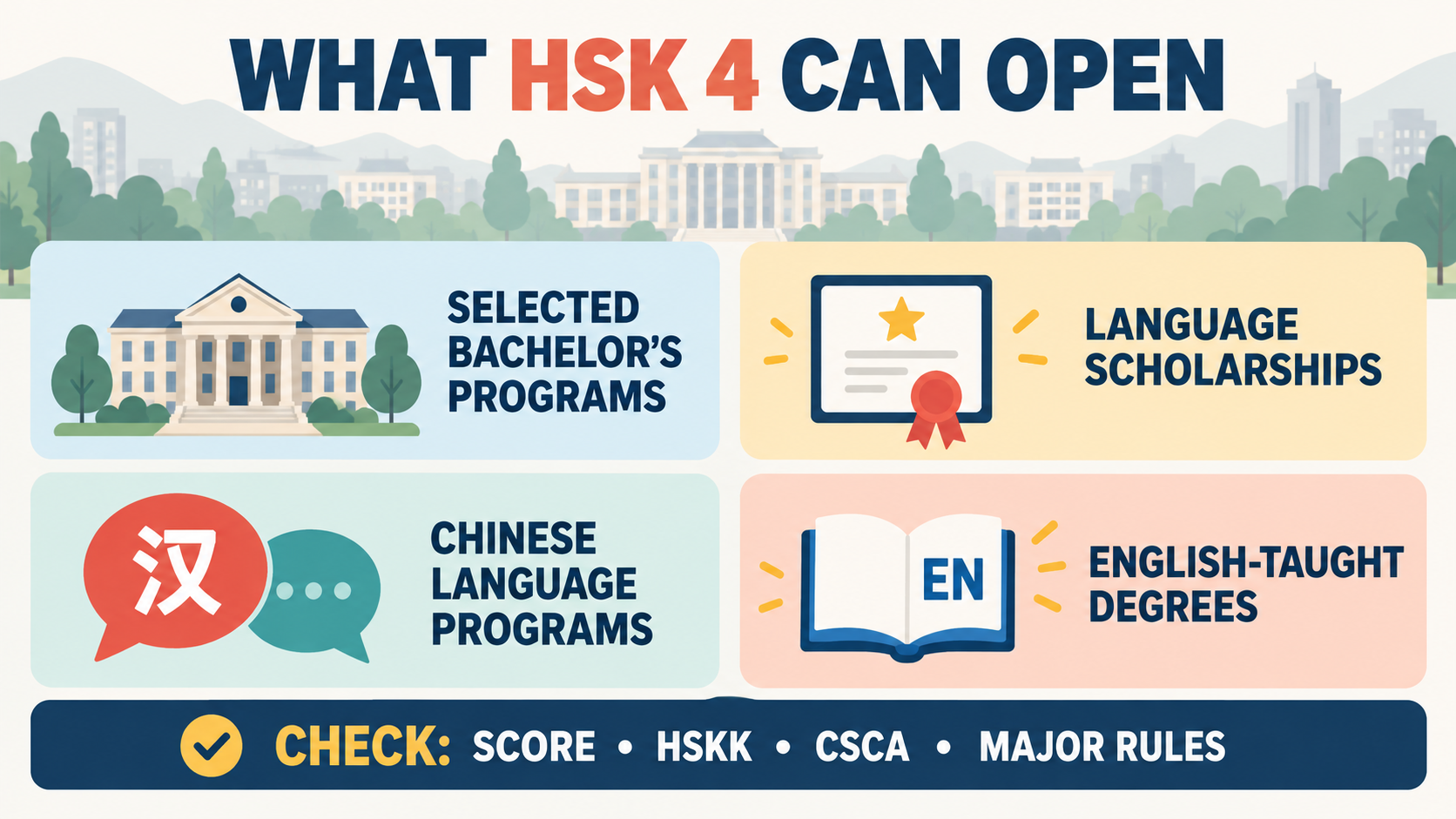
Passing HSK 4 is a real milestone. It usually means you can manage everyday conversations, read practical Chinese and deal with far more situations on your own than a beginner can.
It is also the point where studying in China begins to feel possible rather than hypothetical. Some Chinese-taught bachelor’s programs may now be within reach. University language programs are open to you, and several scholarship routes may be worth exploring.
But there is one thing I would tell any student at this stage: “I have HSK 4” is only the beginning of the answer.
One university may accept HSK 4 with 180 points. Another may ask for 210. A third may want HSK 4 with no section below 60, plus an interview or HSKK. The program, not just the university, determines what you need.
So the useful question is not simply, “Is HSK 4 enough?”
It is, “Is my HSK 4 score enough for this particular program?”
What HSK 4 Can Open
Suggested image placement: hsk4-study-options-infographic.png
Image alt text: Four study paths that may be open to HSK 4 learners in China: selected bachelor’s programs, language scholarships, Chinese language programs and English-taught degrees, with a reminder to check scores, HSKK, CSCA and major-specific rules.
The short answer is encouraging. With HSK 4, you can seriously consider:
- Selected Chinese-taught bachelor’s programs
- Chinese language and preparatory programs
- Some International Chinese Language Teachers Scholarship categories
- English-taught degrees, if you meet the English and academic requirements
- A language-first route leading to a degree that requires HSK 5 or HSK 6
For most direct-entry Chinese-taught master’s programs, however, HSK 4 is usually a bridge rather than the finish line.
Can You Apply for a Bachelor’s Degree with HSK 4?
Yes, sometimes.
This is especially true for programs connected with Chinese language, international Chinese education or subjects designed with international students in mind. Some universities also accept HSK 4 for a wider range of undergraduate majors.
The important word is “some.”
Engineering, medicine, economics, law and other lecture-heavy majors often have higher language requirements because students must follow fast classes, read specialist material and write formal assignments in Chinese. Even when a university’s general admissions page mentions HSK 4, the department may ask for HSK 5.
Before you add a program to your application list, check four things:
- The required HSK level
- The minimum total score
- Any minimum score for listening, reading or writing
- Additional requirements such as HSKK, an interview or CSCA
That last point catches many applicants by surprise. Language ability may be only one part of the decision. A university can also look at your high school grades, mathematics background, entrance test results, personal statement and interview performance.
In other words, HSK 4 may get your application through the first door, but it does not carry the whole application.
What If Your Target Major Requires HSK 5?
Do not cross that program off immediately.
If you are already at HSK 4, moving to HSK 5 is a much more realistic goal than starting from zero. You may be able to take a semester or a year of Chinese language study before beginning the degree. Some universities offer a formal foundation or preparatory route, while others allow students to apply for a separate non-degree language program first.
This route can be a smart choice if:
- Your academic background fits the degree well
- The only major gap is Chinese proficiency
- You have enough time before the next application cycle
- You want to become comfortable studying in Chinese, not merely pass another test
There is no prize for rushing into a degree before you are ready to follow lectures and write assignments. An extra language year can make the first year of university much less stressful.
Can HSK 4 Help You Get a Scholarship?
Yes, but the score printed on your certificate matters.
The International Chinese Language Teachers Scholarship uses combinations of HSK and HSKK scores for different study categories. That means two students who both passed HSK 4 may not have the same scholarship options.
For example, one student may have a strong HSK 4 score but no HSKK result. Another may have both HSK 4 and an intermediate speaking score. The second student may fit more categories even though both casually say, “I have HSK 4.”
When you look at a scholarship, check:
- The exact HSK score required
- Whether HSKK is compulsory
- The required HSKK level and score
- Age and education requirements
- Whether a recommending institution is needed
- What the scholarship actually covers
Do not rely on an old social media post or a screenshot from a previous intake. Scholarship rules and deadlines can change. Use the current application guide for the year in which you plan to study.
Is a Chinese Language Program Still Worth It?
Absolutely.
Some students feel that choosing a language program after passing HSK 4 means they are not progressing fast enough. In reality, it can be the most sensible route if your long-term goal is a Chinese-taught degree.
HSK 4 proves that you have a useful foundation. It does not automatically mean you are ready to understand a two-hour economics lecture, take notes at full speed or write a research paper in Chinese.
A university language program can help you:
- Move from HSK 4 toward HSK 5 or HSK 6
- Improve speaking and pronunciation through daily use
- Learn academic vocabulary for your future major
- Adjust to life in China before starting a demanding degree
- Discover whether studying fully in Chinese is right for you
If you choose this route, look beyond the tuition fee. Ask about class hours, placement tests, class size, HSK preparation, speaking practice, accommodation and whether you can progress into a degree later.
What About an English-Taught Degree?
HSK 4 can still be valuable even when the program is taught in English.
For admission, the university will usually focus on your academic qualifications and proof of English. Depending on the program, that may mean IELTS, TOEFL, previous education in English or another form of language assessment.
Your HSK 4 result may not replace the English requirement, but it can make daily life much easier. You will be better prepared to rent an apartment, visit a clinic, communicate with local classmates and handle ordinary tasks outside the international campus environment.
It can also strengthen the story behind your application. A student who has already invested serious effort in Chinese may appear better prepared for life in China than someone who has never studied the language.
Just be careful not to assume that HSK 4 gives you an admissions advantage everywhere. If the university does not list Chinese as a selection criterion, treat it as a practical strength rather than a guaranteed bonus.
Is HSK 4 Enough for a Master’s Degree?
Usually not for direct entry into a Chinese-taught master’s program.
Graduate study requires more than everyday communication. You may need to read academic papers, discuss abstract ideas, give presentations and write a thesis in Chinese. For that reason, many programs ask for HSK 5 or HSK 6.
Requirements can also vary by subject. A science or engineering program may set one standard, while journalism, law or Chinese literature may set a higher one.
If a Chinese-taught master’s degree is your goal, make a simple note for every target program. Write down:
- The required HSK level and minimum total score
- Any minimum score for individual sections
- Whether HSKK or an interview is required
- Academic and entrance-test requirements
- The application deadline
Then work backward from the deadline and whichever requirement you are still missing. For many HSK 4 students, the most realistic plan is language study first and the master’s application later.
Why Your Exact HSK 4 Score Matters
Two students can both say, “I passed HSK 4,” and still have very different choices.
Imagine that one student scored 181 and another scored 248. Both have an HSK 4 certificate, but a program that asks for 210 points is open only to the second student.
Section scores can matter too. A university may worry about a low writing score even when the total is high enough. Scholarship programs may also combine HSK and HSKK requirements.
Before searching for universities, keep these details in front of you:
- Your HSK level
- Your total score
- Your listening, reading and writing scores
- Your HSKK level and score, if you have one
- The validity rules applied by the institution
That gives you a much more accurate search than typing “universities accepting HSK 4” and applying to every result.
A Better Way to Build Your University List
Start with three groups.
Your first group should contain safer options. These are programs where you clearly meet the published language and academic requirements.
Your second group should contain realistic options. You meet the main requirements, but admission may depend on competition, an interview or additional documents.
Your third group can contain ambitious options. Perhaps your score is close to the minimum, or you need to pass HSK 5 before enrollment.
For every program, save a screenshot or PDF of the current requirement page and note the date you checked it. University websites are updated, and the wording can change between intakes.
If anything is unclear, email the admissions office with a specific question. Instead of writing, “Can I apply with HSK 4?” include your total score, section scores, HSKK result, intended major and planned intake. A precise question is much more likely to receive a useful answer.
Common Mistakes to Avoid
The first mistake is treating all HSK 4 certificates as identical. They are not. Total score and section scores may change your options.
The second is checking only the university’s general requirement. The department or individual program may publish a stricter rule.
The third is ignoring HSKK. This matters especially for language-teaching scholarships and programs that care about spoken Chinese.
The fourth is assuming that an English-taught degree has no language requirement at all. It may not require HSK, but it can still require IELTS, TOEFL or another proof of English.
The fifth is using last year’s requirements without checking the current intake. A page that was accurate twelve months ago may now be out of date.
What Should You Do Next?
If you have HSK 4 today, your next step depends on the program you want—not on the certificate alone.
If your target program accepts your exact score, prepare the rest of the application and do not wait unnecessarily.
If the program asks for a higher HSK 4 score, retaking the exam may be faster than moving straight to HSK 5.
If it requires HSK 5, decide whether you can reach that level before the deadline or whether a language-first route makes more sense.
If you are applying for a scholarship, check HSKK early. Speaking-test dates may not line up neatly with application deadlines.
And if your degree is taught in English, focus first on the academic and English-language criteria while continuing Chinese for daily life.
Final Thoughts
HSK 4 is valuable because it creates genuine options. Selected bachelor’s programs, language scholarships, Chinese language study, preparatory routes and English-taught degrees may all be possible.
Just do not treat it as a universal admissions guarantee.
Think of HSK 4 as a keyring rather than a master key. Several doors may open, but you still have to match the right key to the right program.
Start with your exact score report, choose a specific subject and intake, and verify every requirement on the current official admissions page. That is the point where “I have HSK 4” turns into a real study plan.


