
How to Register for the HSK Test in 2026: A Step-by-Step Guide
 360
 11/16/2026
Why This Guide Matters in 2026
If you are learning Mandarin and need an official certificate for university admission, a job application, or a scholarship, the HSK (Hanyu Shuiping Kaoshi) is the exam you will almost certainly take. It is the standardized Chinese proficiency test administered by the Center for Language Education and Cooperation (CLEC) under China's Ministry of Education, and it is recognized by universities, employers, and government agencies around the world.
Registering for the HSK is not difficult, but the process has several steps, and in 2026 there is an important complication: the brand-new HSK 3.0 format is rolling out globally on December 13, 2026. This guide walks you through everything, step by step, so you can register correctly and avoid the most common mistakes.
Step 1: Understand Which HSK You Should Take
The two formats you may encounter in 2026
HSK 2.0 (six levels): The traditional format most test centers have used for years. Levels 1-6, from absolute beginner (HSK 1) to upper-intermediate/advanced (HSK 6). Speaking is a separate optional test called HSKK.
HSK 3.0 (three stages, nine levels): The upgraded framework launched worldwide on December 13, 2026. It expands the scale to nine levels grouped into three stages - Elementary (Levels 1-3), Intermediate (Levels 4-6), and Advanced (Levels 7-9, a single combined exam scored into three bands). Most importantly, speaking and writing are integrated into every level.
Which one applies to you?
The rule is simple: check your test center and test date. If your session takes place on December 13, 2026 or later, you will sit the HSK 3.0 format. Earlier sessions in 2026 generally followed the HSK 2.0 format, although several global pilot sessions of HSK 3.0 were also held during the year (January 31 and September 20, 2026).
A practical note for university applicants: HSK Level 4 is the baseline language requirement for undergraduate admission at most Chinese universities, and many graduate programs ask for HSK 5 or 6. Under the new framework, universities are gradually updating their requirements, so always confirm with the school you are applying to.
A quick level reference
LevelCumulative vocabulary (approx.)What it meansHSK 1 / Band 1150 (2.0) / ~500 (3.0)Very basic phrasesHSK 2 / Band 2300 / ~772Simple daily communicationHSK 3 / Band 3600Basic academic and daily tasks; speaking required in 3.0HSK 4 / Band 41,200Minimum for university admission in ChinaHSK 5 / Band 52,500News, films, fluent daily discussionHSK 6 / Band 65,000-5,500Comfortable reading of newspapers and magazinesBands 7-9~11,000Academic and professional Chinese; includes translation
Step 2: Pick Your Test Date and Format
The HSK is offered roughly once a month. In 2026, the remaining sessions are:
November 7, 2026 (Saturday) - paper + internet-based; registration closed October 11 (paper) / October 28 (computer)
December 13, 2026 (Sunday) - the official global launch of HSK 3.0; paper registration closes November 16, 2026 at 24:00 (Beijing Time), computer-based registration closes December 3, 2026 at 24:00 (Beijing Time)
Two test formats are available:
Paper-based test: You write your answers by hand on an answer sheet. Results are released about 30 days after the exam.
Computer/internet-based test: You type your answers on a computer at the test center. Results are released about 15 days after the exam - typically two weeks faster than paper.
There is also a Home Edition internet-based test in some regions, which you can take from home under remote proctoring. Availability varies by country, so check your local test center.
Which format should you choose? If you type Chinese characters comfortably but your handwriting is weak, choose the computer-based test. If you plan to use handwriting in daily life or your university specifically requires writing ability, choose paper. Also note: if you choose paper, register early - paper seats at popular test centers fill up quickly.
Step 3: Find Your Test Center
The official registration website is www.chinesetest.cn (the Chinese Tests Service Website, run by Chinese Testing International, CTI). This is the only official channel for individual registration - beware of third-party sites that charge markup fees.
Steps to find a center:
Go to www.chinesetest.cn. The site is available in Chinese and English (plus several other languages).
Use the test center search and filter by your country and city.
Open the center's page to see which test dates, levels, and formats it offers. Not every center offers every session, and some centers are HSKK (speaking) or Home Edition only.
Note the center's contact information - if you have questions about seating or special accommodations, contact them directly before registering.
HSK tests are currently administered in about 169 countries and regions at more than 1,500 test centers, so unless you are in a very remote location, you should find a center within reach.
Step 4: Create an Account on chinesetest.cn
On www.chinesetest.cn, click Register to create a personal account.
Provide your name exactly as it appears on the ID document you will present on test day. This is critical: the name on your admission ticket must match your passport or national ID. Mismatched names are one of the most common reasons candidates are refused entry on test day.
Verify your email address and complete your profile (nationality, date of birth, ID type and number).
Upload a standard ID photo if prompted - usually a recent passport-style photo in color, JPEG format.
Keep your login details safe. You will use the same account later to download your admission ticket and check your scores.
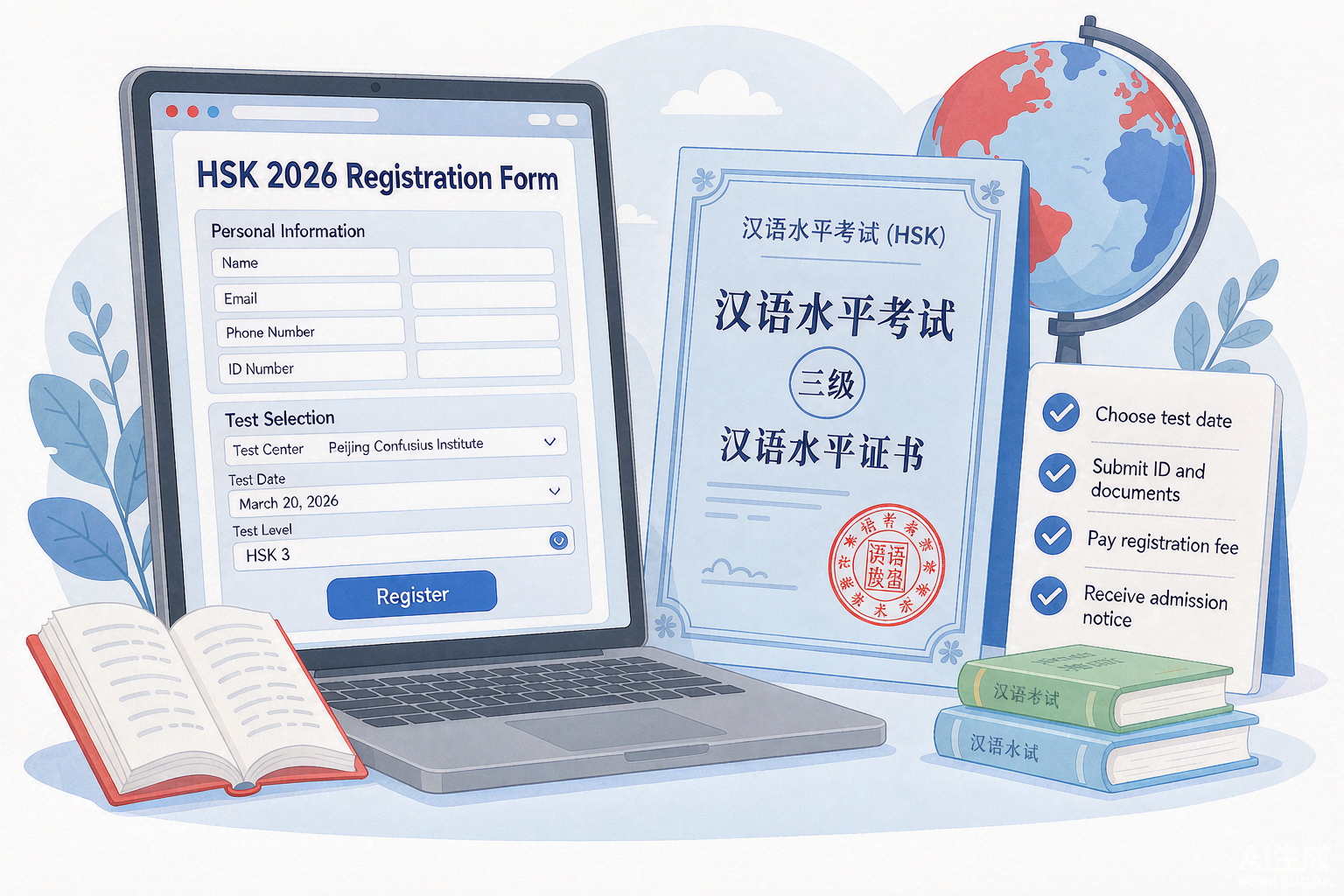
Step 5: Register for Your Test Session
Once logged in:
Click Register for a Test and select the test you want - HSK written test, HSKK speaking test, or both.
Choose your country, city, test center, and test date from the lists.
Choose your level. Important: under HSK 3.0, candidates registering for Levels 3-6 must register for the corresponding speaking test at the same time - it is bundled, not optional.
Fill in the application form and double-check every personal field.
Pay the fee. Payment methods depend on the test center: international credit card, PayPal, or local payment in some countries. Fees vary by country and level; expect roughly USD 20-90 for the written test depending on level (higher levels cost more), plus a separate fee for HSKK if applicable.
After payment, you will receive a confirmation email. Your registration is complete only when payment is confirmed.
Registration deadlines matter: paper-based registration usually closes about a month before the test date; computer-based registration closes about ten days before. There are no late registrations, so set a reminder.
Step 6: Prepare for Test Day
About 10 days before the test, log back into www.chinesetest.cn and download your admission ticket. Print it - it is required for entry along with the original ID document you registered with.
On test day, bring:
Your printed admission ticket
The original ID document used during registration (passport or national ID) - photocopies are not accepted
2B pencils and an eraser (for paper tests) - the test center may provide them, but bring your own to be safe
Arrive early. For paper tests, arrive before the time stated on your admission ticket; late arrivals are generally not admitted, and no refund is given.
For computer-based tests, you will complete a short practice/warm-up on screen before the real exam begins, so get comfortable with typing Chinese characters (pinyin input) in advance if you chose that format.
Step 7: Check Your Results and Use Your Certificate
Scores are released on www.chinesetest.cn: about 15 days after computer-based tests, about 30 days after paper tests.
Your score report remains valid for two years from the test date - plan university or job applications around this window.
You can apply for a paper certificate through the website or your test center.
If you are unhappy with your result, you can register for the next session right away - there is no limit on attempts and no waiting period.
Common Registration Mistakes to Avoid
Name mismatch between account and ID. Register with the name exactly as printed on the ID you bring on test day.
Registering on a third-party site that resells seats at inflated prices. Only use www.chinesetest.cn.
Missing the bundled speaking test. Under HSK 3.0, Levels 3-6 speaking components must be registered together with the written test.
Choosing a level too high. It is better to pass HSK 4 cleanly than to fail HSK 5. Check official vocabulary lists and take a mock test first - you can take a free placement test on our site hsktest.ai to find your level.
Waiting until the deadline to pay. Unpaid registrations expire, and popular centers sell out weeks in advance.
What's Next: Preparing for HSK 3.0
If you are registering for the December 13, 2026 session or any session after that, you are preparing for HSK 3.0. The biggest change is that speaking and writing are now part of every level - even Level 1-2 candidates will produce spoken output, and from Level 3 upward you must write short passages. Learners who relied only on listening and reading apps will find the new format challenging, so adjust your preparation early.
Ready to find out which HSK level suits you? Take our free online HSK mock test and placement assessment at hsktest.ai, then use the official vocabulary lists for your level. Good luck with your registration - and your exam!


