
I Understand Every Word in HSK Reading, but I Still Choose the Wrong Answer—Why?
 409
 11/10/2026
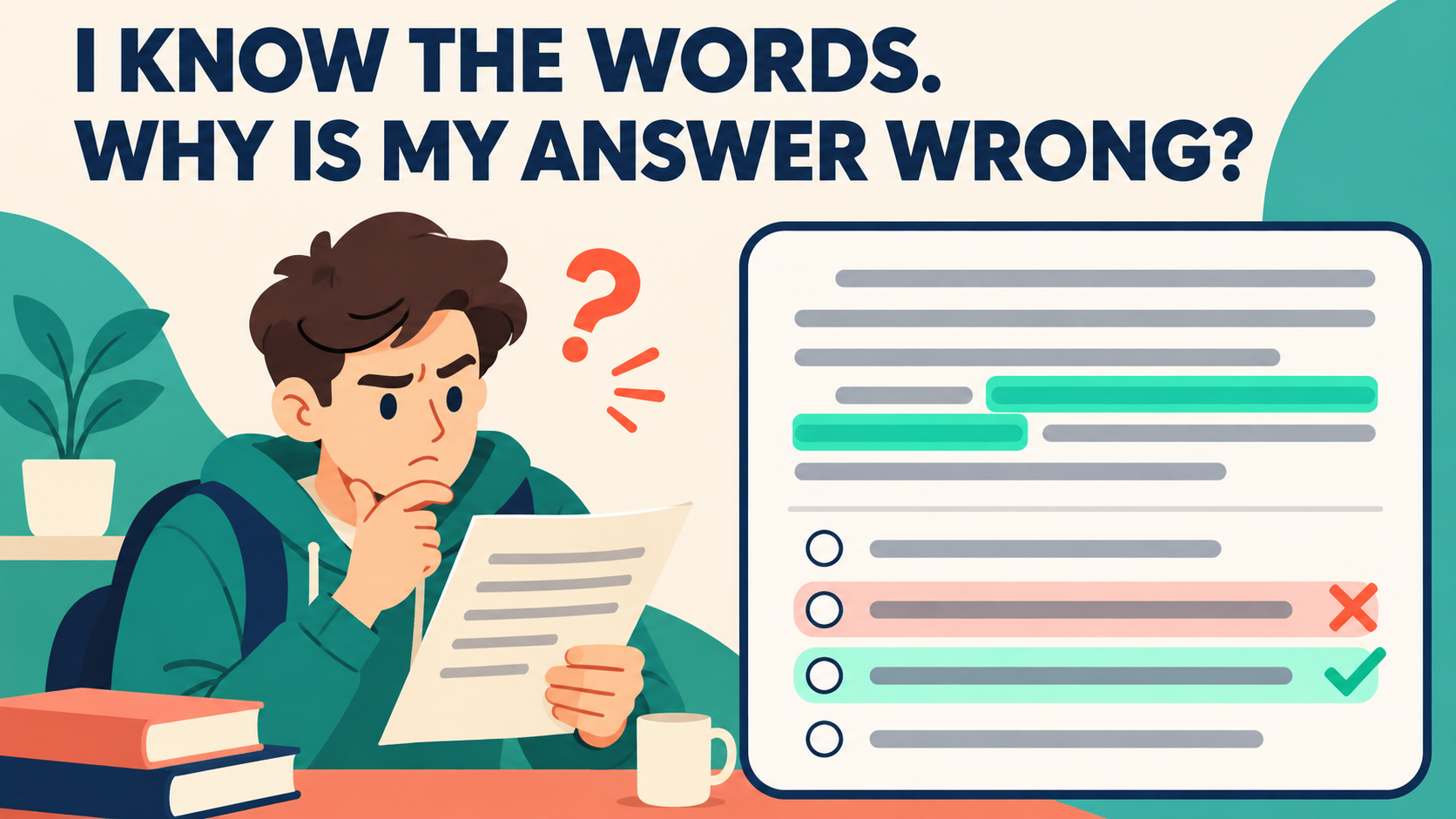
You finish an HSK reading passage feeling confident. Nearly every word looks familiar, the sentences seem clear, and one option feels obviously right. Then you check the answer and discover that you chose the distractor again.
After this happens several times, it is easy to worry that your Chinese is not improving. But the problem is often more specific—and much easier to fix. Once vocabulary is no longer the main obstacle, HSK reading becomes a test of how accurately you compare meaning, follow logic, and judge evidence.
Knowing the words is only the first layer
A good distractor rarely looks completely wrong. It usually borrows words from the passage, keeps part of the original meaning, and changes one small but important detail. The subject may be different. A cause may become a result. Something that happened in the past may be described as happening now. Familiar vocabulary makes the option feel safe, even when the relationship between the ideas has changed.
Small logic words create another common trap. Expressions such as 但是, 其实, 因此, 除非, 原来 and 并不是 can turn the direction of a sentence. The writer’s real point often appears after a contrast, so missing one short connector can lead to a confident but incorrect answer.
Reference words also deserve more attention than they seem to need. When a paragraph contains several people or ideas, 他, 这, 这样 and 其中 may decide the whole question. Replace the reference word with the person or idea it actually means before choosing an option.
Sometimes an option is true but still does not answer the question. A detail may appear in the passage, yet the question asks for a reason, an attitude or the main idea. Before looking at the choices, identify what kind of information the question requires.
The final trap is adding information that the passage never gives. An option may sound logical in real life, but HSK reading rewards textual evidence, not a reasonable guess. If no sentence supports the claim, treat it as an assumption.
Move from “It looks right” to “The passage proves it”
A simple evidence-first routine can make your decisions much more stable.
First, read the question and describe the task in a few words: reason, result, attitude, main idea or detail.
Second, predict the kind of answer you need before reading the options. This prevents the first familiar phrase from controlling your decision.
Third, return to the passage and mark the smallest piece of text that answers the question. You do not need to translate the entire paragraph again.
Fourth, compare each option with the evidence. Check the subject, time, degree and direction of meaning. Words such as always, only, completely and definitely often make an option stronger than the original text.
Finally, if the answer is wrong, name the reason. Was it repeated vocabulary, a missed contrast, a confused reference, the wrong question type or an unsupported inference?
A reliable answer must pass two tests at the same time: it answers the exact question, and the passage provides enough evidence for it. Passing only one test is not enough.
Review without repeating the same mistake
Reading the explanation and thinking “That makes sense” creates recognition, but not correction. The useful question is not only why the correct answer is right. It is why the wrong answer looked attractive at the time.
Keep a short error log with one label for each missed question. After several practice sets, a pattern usually appears. If most errors come from contrast words, practise locating the writer’s final position. If reference words cause trouble, rewrite them with their exact meaning. If unsupported inference is the problem, require yourself to point to a sentence before choosing.
When time is short, do not reread the whole passage from the beginning. Find the part connected to the question, read one or two sentences around it, and compare the choices against that evidence. This is faster and safer than translating everything again.
A practical seven-day reset
On days one and two, focus only on identifying question types and marking evidence. On days three and four, collect distractors and write one sentence explaining why each is wrong. On day five, practise with a time limit. On day six, redo only questions you previously missed without looking at the explanations. On day seven, take a mixed reading set and compare your error patterns with the start of the week.
HSKTest.AI can make this process easier to follow. Use targeted HSK reading practice to work on a specific weakness, then take a mock exam to see whether the same error returns under realistic time pressure. The value is not simply doing more questions. It is seeing a pattern in your mistakes and choosing the next practice task based on that pattern.
The goal of HSK reading is not to produce a perfect translation of every sentence. It is to make a decision that the text can support. Once the question changes from “Which option contains words I know?” to “Which option can the passage prove?”, reading scores usually become much more stable.


