
I Understand HSK Listening After Replaying It. Why Not the First Time?
 412
 11/09/2026
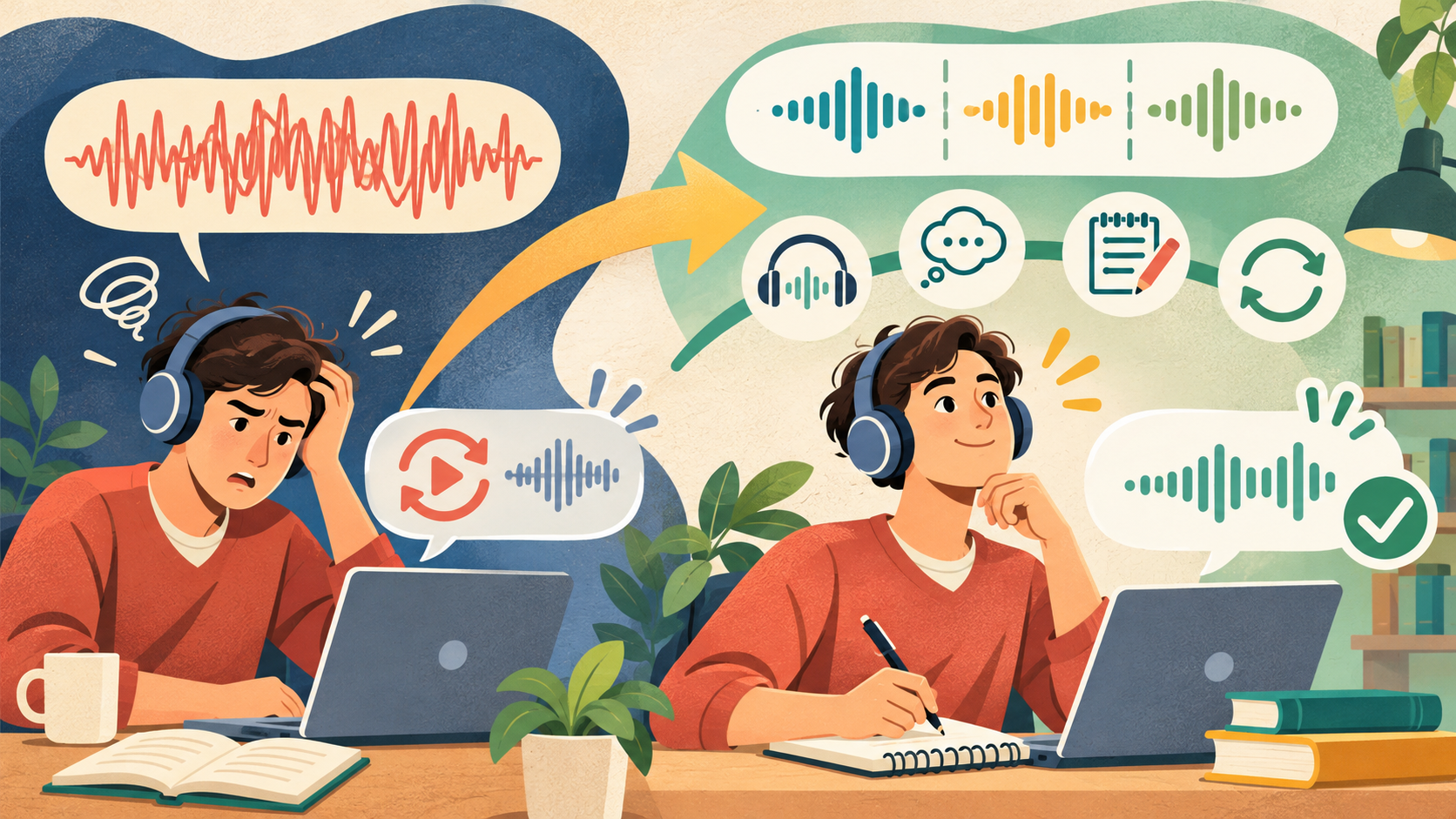
You listen to an HSK question and catch only a few words. You replay it once, then again. On the third listen, the sentence suddenly feels easy.
That can be reassuring, but it also creates a worrying question: if I know the words, why can’t I understand them the first time?
The short answer
If you understand after replaying, your knowledge is probably there, but it is not automatic yet. The first listen may fail because you are translating, waiting for every word, missing connected sounds, or losing focus after one unfamiliar phrase.
Replay helps because you already know the topic and can predict what comes next. In the real HSK exam, the audio does not wait for you to become comfortable. You need to improve first-listen comprehension instead of becoming dependent on replay.
Why the first listen feels so difficult
Written words stay on the page. Spoken language disappears immediately. While you are trying to decode one phrase, the speaker has already moved on.
Four problems are especially common.
First, you recognise characters but not their natural sounds. A word looks familiar in a transcript, but you cannot identify it when it is spoken quickly.
Second, you translate before understanding. If every sentence must pass through your first language, your attention falls behind the recording.
Third, one unknown word takes over your attention. You keep thinking about it and miss the information that actually answers the question.
Fourth, you listen without a purpose. You try to remember every word instead of predicting whether the question is about time, place, attitude, reason, or result.
The hidden risk of unlimited replay
Replay is useful for study, but it can create false confidence. By the third listen, you remember the opening, expect key words, and know where the answer is likely to appear. That is no longer the same task as understanding new audio.
If you always replay before answering, you may become good at recognising familiar recordings without becoming better at handling fresh ones. This gap often appears only in a timed mock exam or the real test.
A better three-listen method
On the first listen, do not pause. Choose an answer or write one sentence about the main idea. Record how confident you feel.
On the second listen, focus on the missing information. Was it the speaker’s opinion, a reason, a number, a change, or a final decision?
On the third listen, check the language. Notice the sound you missed, the synonym that replaced a word in the answer choice, or the connector that changed the meaning.
Only then should you read the transcript. Use it to find the cause of the mistake, not to replace listening.
What should you practise?
If the transcript is easy but the audio is hard, practise sound recognition with short dictation, shadowing, and sentence-level listening.
If you hear the words but lose the meaning, practise listening in chunks. Follow groups of words and connectors instead of processing every character separately.
If you understand the recording but choose the wrong answer, practise question strategy. Identify exactly what the question asks before the key information arrives.
If one difficult phrase makes you lose the rest, practise recovery. Let the missed word go and return your attention to the speaker’s next complete idea.
A seven-day first-listen plan
Day 1: Complete a short timed listening set without replay. Record the question types you miss.
Day 2: Compare five missed sentences with their transcripts. Mark words you knew on paper but failed to hear.
Day 3: Shadow ten short sentences. Copy the rhythm without stopping to translate.
Day 4: Listen to a new set and write only the main idea after one play.
Day 5: Practise your weakest question type, such as attitude, reason, time, or location.
Day 6: Complete another timed set. Replay only after you have submitted your first answer.
Day 7: Compare the two results. Measure first-listen accuracy, not how many times you eventually understood.
How HSKTest.AI can help
It is difficult to improve when you only know that an answer was wrong. You also need to see which question types cause problems, whether timing affects you, and whether the same mistakes repeat.
Use the HSKTest.AI practice area to train listening and review specific weaknesses. Then take a timed mock exam to check whether your improvement survives when the audio is new and replay is unavailable.
Start targeted practice at https://www.hsktest.ai/hsk/practice
Check your first-listen performance at https://www.hsktest.ai/hsk/exam
Do not aim to hear every word. Aim to follow the meaning, recover quickly, and capture the information the question actually needs.
If the third replay feels easy, that is evidence that the language is already close. Now train yourself to access it on the first listen.


