
AI Chinese Writing Feedback: 5 Original Before-and-After Examples for HSK Learners
 432
 11/09/2026

How should you use AI feedback on Chinese writing?
Read the feedback as a suggestion to check, not a finished essay to copy. Confirm what you meant, identify one specific problem, make the smallest useful revision, and then write a new sentence without the model. The useful result is a choice you can explain and repeat, not simply a more polished paragraph.
For HSK learners, this keeps writing practice focused on language and task completion. The examples below are newly written editorial teaching examples, not real student submissions, captured AI outputs, official questions or score reports. Some drafts contain an error; others are grammatical but vague or off task.
A four-step revision workflow
Save your original draft and the task. Add a short note explaining your intended meaning before judging any correction.
Separate a language correction from an optional style change or a request for more information. Do not treat every rewritten word as proof of an error.
Revise one issue at a time. Keep your facts, opinion and level of expression unless you deliberately decide to change them.
Cover the revised version and create a fresh sentence or short response. Record the recurring issue in your own words.
Five original before-and-after examples
These are possible revisions for the stated context, not the only correct wording. The pinyin supports reading; try rewriting the Chinese before checking it. The fictional details in examples 4 and 5 are explicitly supplied by the writer within the teaching scenario, not invented as evidence about a real learner.
01. Fix a word partnership before adding advanced vocabulary
Writer’s intended meaning or supplied context: The writer wants to improve their Chinese proficiency.
Draft to review: 我想增加我的中文水平。
Possible revision: 我想提高我的中文水平。
Pinyin of the revision: Wǒ xiǎng tígāo wǒ de Zhōngwén shuǐpíng.
Meaning of the revision: I want to improve my Chinese proficiency.
What changed and why: 提高 naturally combines with 水平 when describing improvement in ability. 增加 usually describes an increase in amount or number. This is a word-choice correction, not a reason to replace every simple word with a more difficult one.
Next practice task: Write another sentence with 提高 and an ability you actually want to improve.
02. Make time, place and duration easy to follow
Writer’s intended meaning or supplied context: The writer studied Chinese in the library for two hours yesterday.
Draft to review: 我昨天学习中文在图书馆两个小时。
Possible revision: 昨天我在图书馆学了两个小时中文。
Pinyin of the revision: Zuótiān wǒ zài túshūguǎn xué le liǎng ge xiǎoshí Zhōngwén.
Meaning of the revision: Yesterday I studied Chinese in the library for two hours.
What changed and why: Place 在图书馆 before the main action. 学了两个小时中文 connects the action with its duration. The revision preserves the place and length of study; it does not turn the sentence into a claim about how long the journey took. 我昨天在图书馆学了两个小时中文 is also natural.
Next practice task: Change the activity and duration, then explain which words state the location.
03. Choose the relationship before choosing a connector
Writer’s intended meaning or supplied context: In this fictional example, the writer attributes progress to daily practice.
Draft to review: 虽然我每天练习,所以我进步了。
Possible revision: 因为我每天练习,所以我进步了。
Pinyin of the revision: Yīnwèi wǒ měitiān liànxí, suǒyǐ wǒ jìnbù le.
Meaning of the revision: Because I practise every day, I have made progress.
What changed and why: The intended relationship is cause and result, so 因为…所以… fits. If the intended point were contrast, a different sentence such as 虽然我每天练习,但是进步还不明显 would be needed. Never accept a connector change without checking your meaning. This example makes no promise about anyone’s actual progress.
Next practice task: Write one cause-and-result sentence and one contrasting sentence about a topic you know.
04. Replace vague praise with facts the writer supplies
Writer’s intended meaning or supplied context: For this fictional revision, the writer adds two facts: the method is five minutes of daily dictation, and it helps identify words they mishear.
Draft to review: 这个方法很好。我喜欢这个方法。这个方法对我有帮助。
Possible revision: 我每天听写五分钟。这个练习能帮助我发现容易听错的词,所以我想继续坚持。
Pinyin of the revision: Wǒ měitiān tīngxiě wǔ fēnzhōng. Zhège liànxí néng bāngzhù wǒ fāxiàn róngyì tīng cuò de cí, suǒyǐ wǒ xiǎng jìxù jiānchí.
Meaning of the revision: I do five minutes of dictation every day. This practice helps me notice words I easily mishear, so I want to keep doing it.
What changed and why: The draft is not automatically ungrammatical; it is repetitive and vague. The revision becomes specific only because the writer supplies the missing facts. An assistant should ask what the method is and how it helps, not invent a routine, score increase or personal experience.
Next practice task: Take a vague sentence of your own and add one true, relevant detail.
05. Answer the task instead of polishing an off-topic sentence
Writer’s intended meaning or supplied context: Teaching prompt: compare online and in-person classes and state a preference. The fictional writer confirms preferring in-person classes because they want to ask a teacher directly.
Draft to review: 我喜欢学中文。中文很有意思。
Possible revision: 线上课省去通勤时间,线下课更方便当面提问。我更喜欢线下课,因为我希望有问题时能马上请教老师。
Pinyin of the revision: Xiànshàng kè shěng qù tōngqín shíjiān, xiànxià kè gèng fāngbiàn dāngmiàn tíwèn. Wǒ gèng xǐhuan xiànxià kè, yīnwèi wǒ xīwàng yǒu wèntí shí néng mǎshàng qǐngjiào lǎoshī.
Meaning of the revision: Online classes remove commuting time; in-person classes make it easier to ask questions face to face. I prefer in-person classes because I want to consult the teacher as soon as I have a question.
What changed and why: The original sentences may be correct, but they do not compare the two options. The revision addresses the comparison and the writer’s confirmed preference. This is a task-response improvement, not proof of an official score. Do not assume every class provides instant answers.
Next practice task: Underline the comparison and the stated choice, then check both against the prompt.

A question that makes feedback more useful
You can ask a writing assistant or teacher: “Point to the original phrase, explain the problem in simple language, and suggest a small revision that keeps my meaning. Separate required corrections from optional style changes. If a detail is missing, ask me rather than adding a fact.” Use this as a review question wherever explanations are supported, not as a claim about a specific product screen.
How to check whether you learned the correction
Does the revision preserve the person, time, place and opinion I intended?
Did it add any experience, statistic, routine or promise I did not provide?
Can I explain the change as vocabulary, structure, logic, detail or task response?
Can I still understand and use the revised sentence myself?
Can I apply the point to a fresh sentence without copying?
A practical follow-up is to write three new sentences about a different topic, using one point from the examples. Return later and check them without reading the model. This is a suggested practice activity, not an official test or timing rule.
If feedback contradicts itself or changes your meaning, keep both versions and ask a teacher to clarify. An AI score or a fluent rewrite alone cannot establish that a response meets the requirements of your booked examination.
To explore support for regular revision, view AI writing correction. If your recurring issue is word order, continue with 10 original sentence-order exercises. To turn repeated errors into a study plan, use the mock-test review and error-log guide. Choose the task that addresses your actual draft rather than rewriting everything at once.
Frequently asked questions
Should I accept every AI correction?
No. Check the intended meaning, grammar explanation and task. Some changes are optional style preferences. Ask for clarification when a suggestion adds a fact or conflicts with your meaning.
Can a correct sentence still need revision?
Yes. It may be repetitive, vague or unrelated to the task. Label that as a clarity or task-response improvement rather than claiming the original grammar was wrong.
Should I use a more advanced rewrite?
Use wording you understand and can reproduce. A simpler accurate sentence may serve your purpose better than a complex sentence you cannot explain.
Does an AI writing score guarantee my official HSK score?
No. AI feedback is a learning aid. Official assessment depends on the actual examination, task and marking process. These examples do not claim a score gain or guaranteed outcome.
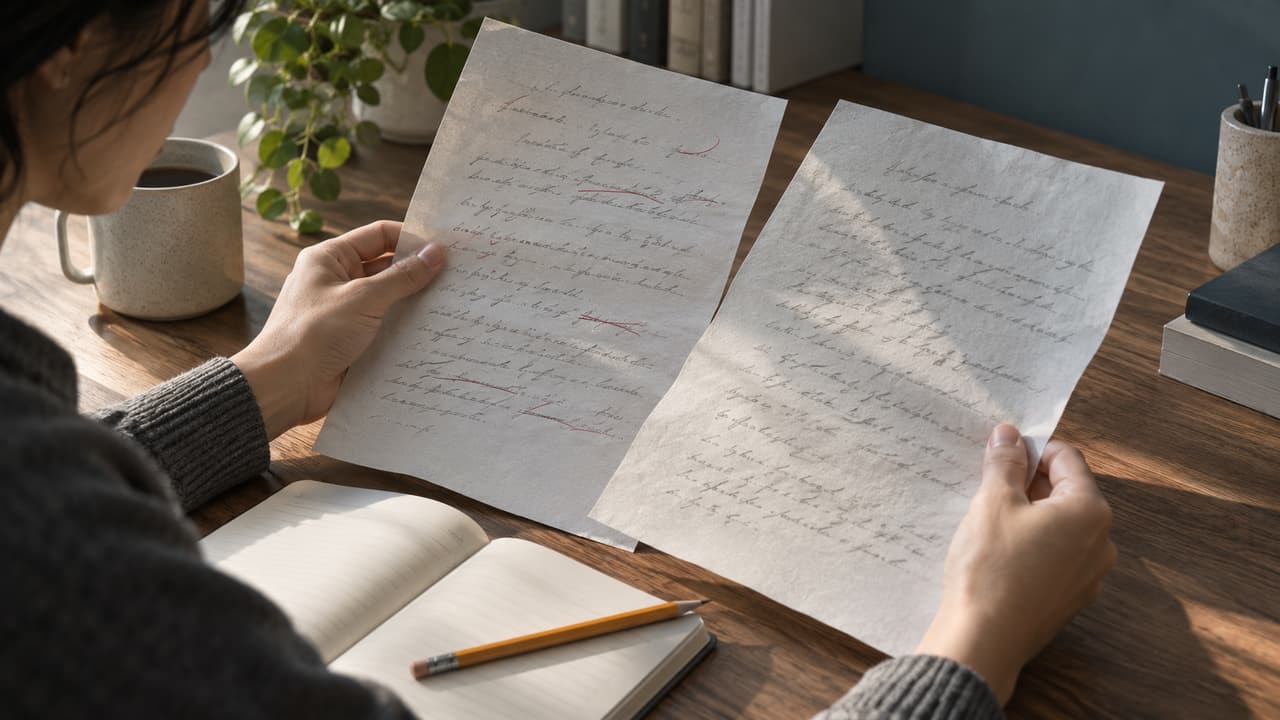
Editorial note: all drafts, revisions and explanations were created for this article. They do not document a product test or a real learner’s results. Images are AI-generated study-scene illustrations.


