

HSKK Intermediate Picture Description: 8 Original Practice Tasks with Sample Answers
 592
 11/04/2026

How do you describe a picture in HSKK Intermediate?
Start by saying who is in the picture, where they are and what they are doing. Add two or three relevant details, connect the actions and develop a short, coherent description. If you imagine what happened before or what may happen next, make the uncertainty clear with words such as 可能 (kěnéng, “possibly”) or 好像 (hǎoxiàng, “it seems”).
The goal of these exercises is to help you turn a picture into connected spoken Chinese. You will find eight original practice scenes below, each with a short starting sentence, a longer Chinese sample, pinyin, an English translation and an explanation of how the response is built.
About these materials: The illustrations and practice responses were created for this article with AI assistance. They are unofficial practice materials, not past examination questions or official scored answers. Each response is one possible approach, not the only acceptable answer.
What is the HSKK Intermediate picture-description task?
The current Chinese Tests Service Website lists two picture-description questions with four minutes in total for HSK Speaking (Intermediate). See the official test structure.
For the exercises below, set a two-minute timer per picture. This is a practical division of the section's total time. Follow the instructions for your actual test, and check whether your registration is for HSKK or a different HSK speaking format.
These eight pictures are a practice collection, not a complete mock examination. The sample responses are intentionally concise: do not assume that reading one aloud will fill two minutes. Use the extension prompt to develop your own response, then check the length with a recording.
A flexible way to organise your answer
Use this sequence as a planning aid, rather than a script to recite:
1. Establish the scene — People, place and main action; 图片里有…… / 他们正在……
2. Select details — Two or three things that help explain the scene; 旁边…… / 其中一位……
3. Connect the actions — Explain how the people or events relate; 一个人……另一个人…… / 因为……所以……
4. Develop and finish — A cautious interpretation or a short relevant comment; 可能…… / 好像…… / 我觉得……
You do not have to use every pattern. Accurate, connected sentences are more useful than a complicated structure you cannot control. Keep the picture as the centre of your response; a personal example should support it, not replace it.
For example, 两个人在公园里跑步。 is a correct starting sentence. It identifies the people, place and action, but it leaves the listener with very little detail. Task 1 shows one way to expand that start.
How to use the eight pictures
Look at the picture before reading any answer. Hide the sample response and translation.
For a first learning attempt, give yourself up to one minute to identify three keywords. This is a study exercise, not a claim about official preparation time.
Record a response with a two-minute timer. Do not read a prepared script.
Compare your recording with the sample. Choose one content problem and one language problem to improve.
Record again using your own words. On a later attempt, use a new picture to check whether the improvement transfers.
The pictures are grouped into four suggested pairs: 01–02, 03–04, 05–06 and 07–08. You can practise one pair at a time.
Pinyin is included as a reading aid. It mostly shows dictionary tones; normal tone changes in connected speech still apply. Try speaking from the picture before opening the pinyin.
Task 01: Jogging together in a park

What to notice: Name the place and action first. Then add visible details about the two runners and their surroundings.
Useful vocabulary
跑步 — pǎobù; to jog; to run
锻炼 — duànliàn; to exercise
一起 — yìqǐ; together
A short starting sentence
两个人在公园里跑步。
One possible expanded answer
图片里有两个人,他们正在公园里跑步。旁边有很多树,周围的环境很好。穿红色上衣的女士和穿蓝绿色上衣的男士一起向前跑,看起来很开心。他们可能是朋友,也可能是一起锻炼的同事。我觉得和别人一起运动是个好习惯,因为这样不容易放弃。公园里的路比较宽,两个人可以并排向前跑。跑累的时候,他们可以慢慢走一会儿,再继续跑。这样的运动不仅能锻炼身体,也能让人放松心情。
Pinyin
tú piàn lǐ yǒu liǎng gè rén, tā men zhèng zài gōng yuán lǐ pǎo bù。 páng biān yǒu hěn duō shù, zhōu wéi de huán jìng hěn hǎo。 chuān hóng sè shàng yī de nǚ shì hé chuān lán lǜ sè shàng yī de nán shì yì qǐ xiàng qián pǎo, kàn qǐ lái hěn kāi xīn。 tā men kě néng shì péng yǒu, yě kě néng shì yì qǐ duàn liàn de tóng shì。 wǒ jué de hé bié rén yì qǐ yùn dòng shì gè hǎo xí guàn, yīn wèi zhè yàng bù róng yì fàng qì。 gōng yuán lǐ de lù bǐ jiào kuān, liǎng gè rén kě yǐ bìng pái xiàng qián pǎo。 pǎo lèi de shí hòu, tā men kě yǐ màn màn zǒu yī huì er, zài jì xù pǎo。 zhè yàng de yùn dòng bù jǐn néng duàn liàn shēn tǐ, yě néng ràng rén fàng sōng xīn qíng。
English translation
There are two people in the picture. They are jogging in a park. There are many trees nearby, and the surroundings look pleasant. The woman in the red top and the man in the blue-green top are running forward together and look happy. They may be friends, or they may be colleagues exercising together. I think exercising with someone else is a good habit because it makes giving up less likely. The path in the park is fairly wide, so they can run side by side. When they get tired, they can walk slowly for a while before continuing. Exercise like this helps people stay fit and relax.
How this answer is built: The answer moves from visible facts to a clearly signalled guess, then a relevant comment. “可能” avoids pretending that the runners’ relationship is known.
Your extension challenge: Add one real example of exercising with a friend: where you went, what you did and why it helped you continue.
Task 02: Preparing a meal together

What to notice: Distinguish the two actions. Do not assume that the people are married or that the meal is for a celebration.
Useful vocabulary
洗菜 — xǐ cài; to wash vegetables
做饭 — zuò fàn; to cook a meal
一边……一边…… — yìbiān… yìbiān…; to do two things at the same time
A short starting sentence
两个人在厨房里做饭。
One possible expanded answer
这张图片里,两个人正在厨房里准备饭菜。左边的男士在洗菜,右边的女士正在炒菜。桌上还放着一些西红柿。他们分工合作,一个准备材料,一个负责做饭。看起来,他们很享受一起做饭的过程。我觉得在家做饭虽然需要时间,但是可以根据自己的口味选择食物。两个人一起准备,比一个人忙来忙去轻松一些。他们可以一边做饭一边聊天,最后一起吃自己做的菜。这样的饭不一定很贵,却让人觉得很温暖。
Pinyin
zhè zhāng tú piàn lǐ, liǎng gè rén zhèng zài chú fáng lǐ zhǔn bèi fàn cài。 zuǒ biān de nán shì zài xǐ cài, yòu biān de nǚ shì zhèng zài chǎo cài。 zhuō shàng hái fàng zhe yī xiē xī hóng shì。 tā men fēn gōng hé zuò, yí gè zhǔn bèi cái liào, yí gè fù zé zuò fàn。 kàn qǐ lái, tā men hěn xiǎng shòu yì qǐ zuò fàn de guò chéng。 wǒ jué de zài jiā zuò fàn suī rán xū yào shí jiān, dàn shì kě yǐ gēn jù zì jǐ de kǒu wèi xuǎn zé shí wù。 liǎng gè rén yì qǐ zhǔn bèi, bǐ yí gè rén máng lái máng qù qīng sōng yī xiē。 tā men kě yǐ yī biān zuò fàn yī biān liáo tiān, zuì hòu yì qǐ chī zì jǐ zuò de cài。 zhè yàng de fàn bù yí dìng hěn guì, què ràng rén jué de hěn wēn nuǎn。
English translation
In this picture, two people are preparing food in a kitchen. The man on the left is washing vegetables, while the woman on the right is stir-frying. There are also some tomatoes on the counter. They are sharing the work: one prepares the ingredients and the other cooks. They seem to enjoy cooking together. I think cooking at home takes time, but it lets you choose food to suit your taste. Preparing together is a little easier than one person doing everything. They can chat while cooking and then eat what they have made. A meal like this does not have to be expensive to feel warm and welcoming.
How this answer is built: “一个……一个……” organises the description; “虽然……但是……” introduces a connected opinion. Neither structure needs to be used unless you can say it accurately.
Your extension challenge: Explain one dish you can cook and how you would divide the work with a friend.
Task 03: Studying in a library

What to notice: Use the shared book to explain how the two people interact. You do not need to invent their subject or exam date.
Useful vocabulary
图书馆 — túshūguǎn; library
讨论 — tǎolùn; to discuss
解释 — jiěshì; to explain
A short starting sentence
两个学生在图书馆看书。
One possible expanded answer
图片里有两个人,他们坐在图书馆的桌子旁边。桌上放着书、本子和一台电脑。女士指着书上的一个地方,男士认真地看着。他们可能正在讨论一道题,也可能在一起复习。图书馆比较安静,很适合学习。不过,讨论的时候应该注意音量,不要影响别人。两个人一起复习,可以互相帮助。遇到不懂的问题,他们可以先自己想一想,再向对方提问。对着书上的内容解释,比只说答案更清楚。这样不但能解决问题,还能检查自己是不是真的理解了。
Pinyin
tú piàn lǐ yǒu liǎng gè rén, tā men zuò zài tú shū guǎn de zhuō zi páng biān。 zhuō shàng fàng zhe shū、 běn zi hé yī tái diàn nǎo。 nǚ shì zhǐ zhe shū shàng de yí gè dì fāng, nán shì rèn zhēn dì kàn zhe。 tā men kě néng zhèng zài tǎo lùn yī dào tí, yě kě néng zài yì qǐ fù xí。 tú shū guǎn bǐ jiào ān jìng, hěn shì hé xué xí。 bù guò, tǎo lùn de shí hòu yīng gāi zhù yì yīn liàng, bú yào yǐng xiǎng bié rén。 liǎng gè rén yì qǐ fù xí, kě yǐ hù xiāng bāng zhù。 yù dào bù dǒng de wèn tí, tā men kě yǐ xiān zì jǐ xiǎng yī xiǎng, zài xiàng duì fāng tí wèn。 duì zhe shū shàng de nèi róng jiě shì, bǐ zhǐ shuō dá àn gèng qīng chǔ。 zhè yàng bù dàn néng jiě jué wèn tí, hái néng jiǎn chá zì jǐ shì bú shì zhēn de lǐ jiě le。
English translation
There are two people in the picture, sitting at a table in a library. On the table are books, a notebook and a computer. The woman points to a place in the book, and the man looks at it carefully. They may be discussing a question or reviewing together. A library is relatively quiet and suitable for studying. However, people should keep their voices down when discussing things so they do not disturb others. Reviewing together lets them help each other. If they do not understand something, they can think about it first and then ask the other person. Explaining with reference to the book is clearer than simply giving an answer. This helps solve the problem and checks whether we really understand it.
How this answer is built: The response describes an interaction, not just a list of objects. The comment about keeping quiet remains connected to the library scene.
Your extension challenge: Compare studying alone with studying with a classmate, using one specific experience.
Task 04: Offering a seat on a bus
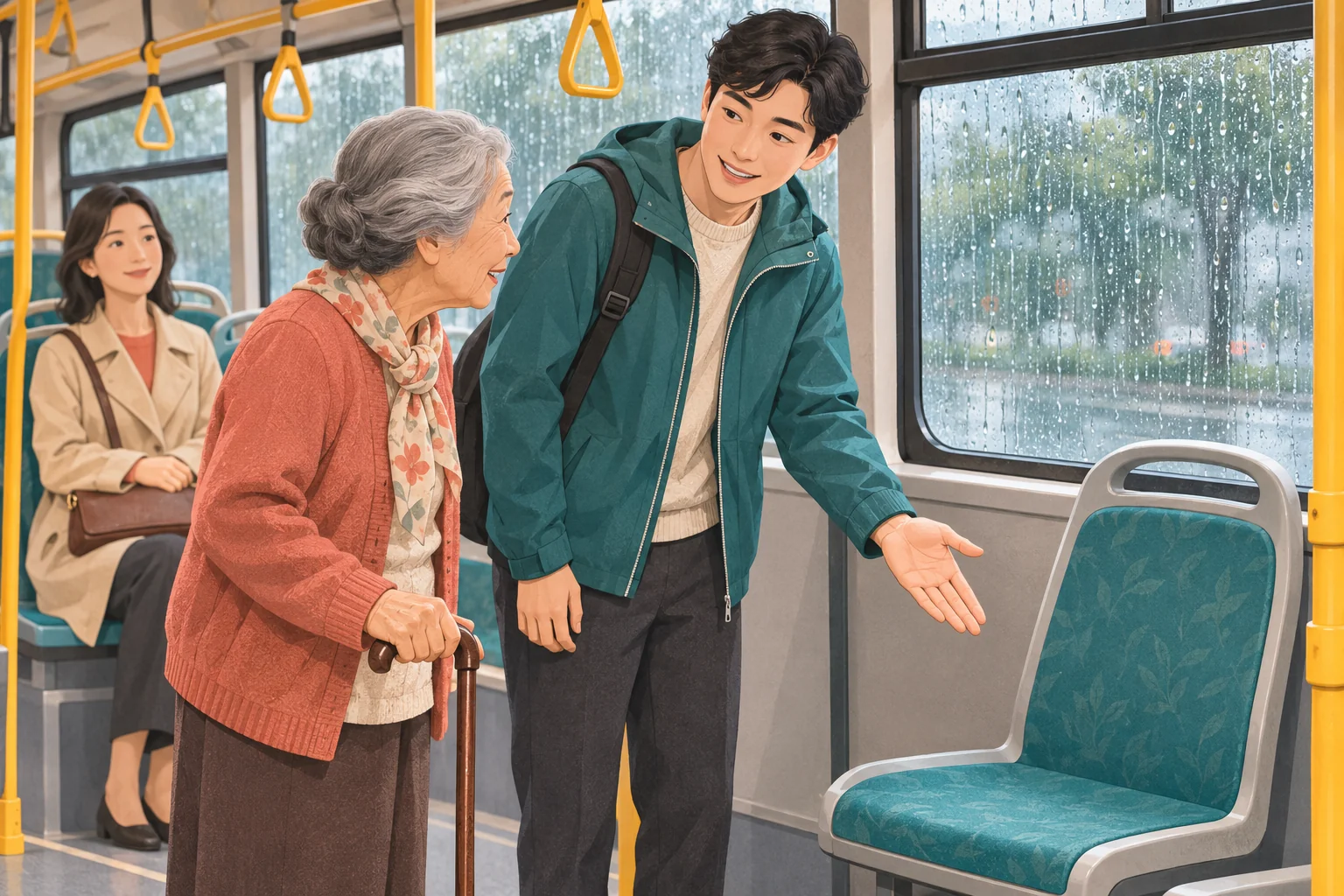
What to notice: Explain the gesture and the empty seat. Describe the action as an offer rather than claiming that the woman has already sat down.
Useful vocabulary
让座 — ràng zuò; to offer someone a seat
老人 — lǎorén; elderly person
帮助 — bāngzhù; to help
A short starting sentence
一个年轻人在公共汽车上让座。
One possible expanded answer
这张图片展示的是公共汽车上的场景。一位老人拿着拐杖,站在一个年轻人旁边。年轻人指着身边的空座位,好像在请她坐下。后面还有一位乘客坐着,窗外正在下雨。我觉得这个年轻人很细心,因为老人站着可能不太方便。坐公共汽车的时候,如果看到需要帮助的人,我们可以主动问一问。年轻人可以先问老人要不要坐下,再让出足够的空间,方便她过去。这样的帮助不需要花很多时间,却能让人感到被关心。
Pinyin
zhè zhāng tú piàn zhǎn shì de shì gōng gòng qì chē shàng de chǎng jǐng。 yī wèi lǎo rén ná zhe guǎi zhàng, zhàn zài yí gè nián qīng rén páng biān。 nián qīng rén zhǐ zhe shēn biān de kōng zuò wèi, hǎo xiàng zài qǐng tā zuò xià。 hòu miàn hái yǒu yī wèi chéng kè zuò zhe, chuāng wài zhèng zài xià yǔ。 wǒ jué de zhè ge nián qīng rén hěn xì xīn, yīn wèi lǎo rén zhàn zhe kě néng bù tài fāng biàn。 zuò gōng gòng qì chē de shí hòu, rú guǒ kàn dào xū yào bāng zhù de rén, wǒ men kě yǐ zhǔ dòng wèn yī wèn。 nián qīng rén kě yǐ xiān wèn lǎo rén yào bù yào zuò xià, zài ràng chū zú gòu de kōng jiān, fāng biàn tā guò qù。 zhè yàng de bāng zhù bù xū yào huā hěn duō shí jiān, què néng ràng rén gǎn dào bèi guān xīn。
English translation
The picture shows a scene on a bus. An elderly woman holding a cane is standing beside a young man. He points to the empty seat next to him, as if inviting her to sit down. Another passenger is seated farther back, and it is raining outside. I think the young man is considerate because standing may be difficult for the elderly woman. When we take a bus and see someone who needs help, we can ask whether they would like assistance. The young man can first ask whether she would like to sit and then leave enough space for her to reach the seat. This kind of help takes little time but can make a person feel cared for.
How this answer is built: “好像” marks an interpretation of the gesture. The suggested next step stays close to the main action instead of turning into an unrelated story.
Your extension challenge: Say how you would politely offer help and what you would do if the passenger declined.
Task 05: Choosing fruit at a supermarket

What to notice: Focus on the customer, employee and fruit. The picture does not establish a price, discount or payment method.
Useful vocabulary
挑选 — tiāoxuǎn; to choose carefully
新鲜 — xīnxiān; fresh
店员 — diànyuán; shop assistant
A short starting sentence
一位女士正在超市买水果。
One possible expanded answer
图片里,一位女士正在超市里买水果。她手里拿着一袋苹果,旁边的店员正在向她介绍。水果区里还有一些橙子,看起来很新鲜。女士可能想了解苹果的味道,也可能在问怎么挑选。买水果的时候,我一般先看看新不新鲜,再比较价格。如果不太了解一种水果,我会问问店员。我觉得购物前列一个简单的清单很有用,可以少买不需要的东西。这样既能节省时间,也不容易浪费食物。
Pinyin
tú piàn lǐ, yī wèi nǚ shì zhèng zài chāo shì lǐ mǎi shuǐ guǒ。 tā shǒu lǐ ná zhe yī dài píng guǒ, páng biān de diàn yuán zhèng zài xiàng tā jiè shào。 shuǐ guǒ qū lǐ hái yǒu yī xiē chéng zi, kàn qǐ lái hěn xīn xiān。 nǚ shì kě néng xiǎng liǎo jiě píng guǒ de wèi dào, yě kě néng zài wèn zěn me tiāo xuǎn。 mǎi shuǐ guǒ de shí hòu, wǒ yì bān xiān kàn kàn xīn bù xīn xiān, zài bǐ jiào jià gé。 rú guǒ bù tài liǎo jiě yī zhǒng shuǐ guǒ, wǒ huì wèn wèn diàn yuán。 wǒ jué de gòu wù qián liè yí gè jiǎn dān de qīng dān hěn yǒu yòng, kě yǐ shǎo mǎi bù xū yào de dōng xī。 zhè yàng jì néng jié shěng shí jiān, yě bù róng yì làng fèi shí wù。
English translation
In the picture, a woman is buying fruit in a supermarket. She is holding a bag of apples, and the employee beside her is explaining something to her. There are also some oranges in the produce section, and the fruit looks fresh. She may want to know how the apples taste or how to choose them. When I buy fruit, I usually check its freshness before comparing prices. If I do not know much about a particular fruit, I ask an employee. I think making a short shopping list helps me avoid buying things I do not need. This saves time and reduces food waste.
How this answer is built: The answer distinguishes observation from possible dialogue. “先……再……” makes the shopping routine easy to follow without inventing a price.
Your extension challenge: Explain what you would ask an employee before buying an unfamiliar fruit.
Task 06: Sharing an umbrella

What to notice: Describe the weather and the shared umbrella. Treat the reason for sharing it as a possibility.
Useful vocabulary
雨伞 — yǔsǎn; umbrella
车站 — chēzhàn; station; stop
忘记 — wàngjì; to forget
A short starting sentence
下雨了,两个人共用一把雨伞。
One possible expanded answer
这张图片里,外面正在下雨,地上也是湿的。两位女士在车站旁边共用一把雨伞,其中一位背着一个包。拿伞的女士把伞往朋友那边移,让两个人都能躲雨。也许其中一个人忘了带伞,所以她们一起走。我觉得这是一件很普通、却很温暖的小事。从图片上看,车站离她们很近,她们可以先在那里等一等。如果雨一直不停,也可以一起坐车离开。一把伞虽然不大,但是两个人互相照顾,就能少淋一点雨。
Pinyin
zhè zhāng tú piàn lǐ, wài miàn zhèng zài xià yǔ, dì shàng yě shì shī de。 liǎng wèi nǚ shì zài chē zhàn páng biān gòng yòng yī bǎ yǔ sǎn, qí zhōng yī wèi bèi zhe yí gè bāo。 ná sǎn de nǚ shì bǎ sǎn wǎng péng yǒu nà biān yí, ràng liǎng gè rén dōu néng duǒ yǔ。 yě xǔ qí zhōng yí gè rén wàng le dài sǎn, suǒ yǐ tā men yì qǐ zǒu。 wǒ jué de zhè shì yī jiàn hěn pǔ tōng、 què hěn wēn nuǎn de xiǎo shì。 cóng tú piàn shàng kàn, chē zhàn lí tā men hěn jìn, tā men kě yǐ xiān zài nà lǐ děng yī děng。 rú guǒ yǔ yì zhí bù tíng, yě kě yǐ yì qǐ zuò chē lí kāi。 yī bǎ sǎn suī rán bù dà, dàn shì liǎng gè rén hù xiāng zhào gù, jiù néng shǎo lín yì diǎn yǔ。
English translation
In this picture, it is raining outside and the ground is wet. Two women are sharing an umbrella beside a bus stop, and one is carrying a backpack. The woman holding the umbrella moves it toward her friend so that both can shelter from the rain. Perhaps one of them forgot her umbrella, so they are walking together. I think this is an ordinary but heartwarming moment. The bus stop looks close, so they could wait there for a while. If the rain does not stop, they could take a bus together. Although one umbrella is not very large, looking out for each other helps both women stay a little drier.
How this answer is built: The response links a visible helpful action to a plausible next step. “也许” makes the forgotten umbrella a guess rather than a claimed fact.
Your extension challenge: Describe one practical way to prepare for bad weather, keeping the umbrella scene as your starting point.
Task 07: Discussing work with colleagues

What to notice: Explain who is presenting and who is listening. Do not invent company names, sales figures or the meeting result.
Useful vocabulary
同事 — tóngshì; colleague
计划 — jìhuà; plan
意见 — yìjiàn; opinion; suggestion
A short starting sentence
三位同事正在开会。
One possible expanded answer
图片里有三个人,他们坐在办公室的桌子旁边。女士指着电脑屏幕,另外两位男士正在听她说话。桌上放着一些文件和水杯,他们可能在讨论一个工作计划。虽然我不知道会议的具体内容,但是可以看出大家正在交流。我觉得一起工作时,认真听别人的意见很重要。如果没有听懂,应该及时提问,而不是一直点头。讨论以后,他们可以确认每个人的任务,再把重要的安排记下来。分工清楚以后,一起检查进度,合作就会更顺利。
Pinyin
tú piàn lǐ yǒu sān gè rén, tā men zuò zài bàn gōng shì de zhuō zi páng biān。 nǚ shì zhǐ zhe diàn nǎo píng mù, lìng wài liǎng wèi nán shì zhèng zài tīng tā shuō huà。 zhuō shàng fàng zhe yī xiē wén jiàn hé shuǐ bēi, tā men kě néng zài tǎo lùn yí gè gōng zuò jì huà。 suī rán wǒ bù zhī dào huì yì de jù tǐ nèi róng, dàn shì kě yǐ kàn chū dà jiā zhèng zài jiāo liú。 wǒ jué de yì qǐ gōng zuò shí, rèn zhēn tīng bié rén de yì jiàn hěn zhòng yào。 rú guǒ méi yǒu tīng dǒng, yīng gāi jí shí tí wèn, ér bú shì yì zhí diǎn tóu。 tǎo lùn yǐ hòu, tā men kě yǐ què rèn měi gè rén de rèn wù, zài bǎ zhòng yào de ān pái jì xià lái。 fēn gōng qīng chǔ yǐ hòu, yì qǐ jiǎn chá jìn dù, hé zuò jiù huì gèng shùn lì。
English translation
There are three people in the picture, sitting at a table in an office. The woman points at the computer screen, and the two men are listening to her. There are documents and water glasses on the table. They may be discussing a work plan. Although I do not know the exact subject of the meeting, I can see that they are exchanging ideas. I think listening carefully to others’ opinions is important when working together. If something is unclear, we should ask questions rather than simply nodding. After the discussion, they could confirm everyone’s tasks and write down important arrangements. Once responsibilities are clear, checking progress together can make cooperation smoother.
How this answer is built: The speaker openly acknowledges what the image cannot reveal. A possible next step develops the teamwork theme without inventing company figures or a meeting result.
Your extension challenge: Give an example of a useful question you could ask when a shared task is unclear.
Task 08: Meeting a friend at a train station

What to notice: Use the suitcase, train and greeting to build the scene. Names, destination and travel duration are not visible facts.
Useful vocabulary
行李箱 — xínglǐxiāng; suitcase
挥手 — huī shǒu; to wave
接朋友 — jiē péngyou; to meet or pick up a friend
A short starting sentence
两个人在火车站见面。
One possible expanded answer
这张图片里,一位女士拉着行李箱,正在向一位男士挥手。男士背着包,也笑着和她打招呼。后面可以看到火车,所以他们应该是在火车站见面。也许女士刚到这个城市,男士来车站接她。他们看起来都很高兴。第一次去不熟悉的地方,有朋友来接会让人安心一些。见面以后,他们可能会先聊一聊路上的情况,再一起离开车站。如果行李比较重,男士也可以帮忙拿一下。对远道而来的朋友来说,这样的欢迎很温暖。
Pinyin
zhè zhāng tú piàn lǐ, yī wèi nǚ shì lā zhe xíng lǐ xiāng, zhèng zài xiàng yī wèi nán shì huī shǒu。 nán shì bèi zhe bāo, yě xiào zhe hé tā dǎ zhāo hū。 hòu miàn kě yǐ kàn dào huǒ chē, suǒ yǐ tā men yīng gāi shì zài huǒ chē zhàn jiàn miàn。 yě xǔ nǚ shì gāng dào zhè ge chéng shì, nán shì lái chē zhàn jiē tā。 tā men kàn qǐ lái dōu hěn gāo xìng。 dì yī cì qù bù shú xī de dì fāng, yǒu péng yǒu lái jiē huì ràng rén ān xīn yī xiē。 jiàn miàn yǐ hòu, tā men kě néng huì xiān liáo yī liáo lù shàng de qíng kuàng, zài yì qǐ lí kāi chē zhàn。 rú guǒ xíng lǐ bǐ jiào zhòng, nán shì yě kě yǐ bāng máng ná yī xià。 duì yuǎn dào ér lái de péng yǒu lái shuō, zhè yàng de huān yíng hěn wēn nuǎn。
English translation
In this picture, a woman is pulling a suitcase and waving to a man. He is wearing a backpack and smiling as he greets her. A train is visible behind them, so they appear to be meeting at a train station. Perhaps the woman has just arrived in the city and the man has come to meet her. They both look happy. When visiting an unfamiliar place for the first time, having a friend meet you can be reassuring. After greeting each other, they may talk about the journey and then leave the station together. If the luggage is heavy, the man could help carry it. For a friend arriving from far away, this is a warm welcome.
How this answer is built: The response uses visible evidence to establish the setting, signals the imagined arrival with “也许”, and finishes with practical details related to meeting a visitor.
Your extension challenge: Explain what you would do if you and your friend could not find each other at the station.
Common picture-description mistakes and better alternatives
Listing objects: “a person, a table, a book” — The listener does not hear what is happening; Put an action in each main sentence: 一位女士正在给同学解释问题。
Inventing names, exact prices or a full backstory — Unsupported detail can distract from the image; Describe visible facts first; introduce a plausible guess with 可能 or 也许
Repeating 很好 or 很开心 — Repetition adds little meaning; Explain what makes the scene pleasant, useful or helpful
Beginning every answer with a memorised opinion speech — The response may take too long to reach the picture; Start directly: 图片里…… / 一位……正在……
Adding an unrelated personal story — The picture disappears from the answer; Keep the example short and return to the scene
Speaking faster to fill the time — Rushing can make pronunciation and meaning less clear; Add relevant detail at a pace you can control
A recording checklist for your next attempt
After listening to your recording, answer these questions:
Did I describe the main action clearly near the beginning?
Did I connect my sentences instead of simply listing things?
Did I distinguish visible information from guesses?
Did I keep my extra details relevant to the picture?
Are there words, tones or sentence patterns I need to practise separately?
Did I finish naturally, without a long silence or repeated filler phrases?
This is a practice checklist, not an official scoring rubric. Compare your first and second recordings using the same questions. Improvement might mean a clearer opening, fewer unfinished sentences or one corrected pronunciation pattern; a longer answer is not automatically a better one.
Turn one recording into targeted speaking practice
If you can see what is happening but struggle to say it, identify the specific obstacle. You may need vocabulary for the action, a more familiar sentence pattern, clearer pronunciation or a better way to connect ideas.
Use HSKTest.ai speaking practice to continue working on your spoken Chinese. If you want feedback on a practice response, explore AI speaking assessment. Review the current product details to see which recording tasks and feedback options are supported.
A useful practice cycle is: record → review one or two problems → practise those points → record again. An AI practice score is not an official HSKK result. Use feedback to guide revision, and seek a teacher's help when a correction or content judgment is unclear.
If your wider challenge is that you passed a written HSK test but cannot respond comfortably in conversation, read I Passed the HSK but Still Can’t Speak Chinese: What Should I Do?.
Frequently asked questions
How many pictures should I practise in one session?
Start with one pair. Two carefully reviewed recordings can be more useful than rushing through all eight pictures without listening again. Return to the same pair later, then try a new scene.
Do I have to use difficult vocabulary?
Choose words you can use accurately. A clear description of who is doing what is a better foundation than a string of difficult words with unclear connections. Add more precise vocabulary when it genuinely helps explain the scene.
Can I imagine a story behind the picture?
You can develop a plausible interpretation, but keep it anchored to the image. Use 可能, 也许 or 好像 when the detail is uncertain. Avoid spending most of the response on events that have no visible connection to the picture.
Should I memorise these sample answers?
Use them to study organisation and expressions. Then hide the text and describe the picture in your own words. Memorising a whole paragraph may make it harder to adapt when the people, setting or action changes.
Are these official HSKK pictures or full-score answers?
No. These are original, AI-assisted practice illustrations and sample responses prepared for this article. They do not reproduce an official paper, carry an official score or guarantee an exam result.
Does this article cover the new HSK 3.0 speaking test?
This article is specifically about the HSKK Intermediate picture-description task. Do not assume that its task types or timing apply to every HSK speaking examination. Confirm the test name and instructions for your booking.
Source and scope
Official reference: Chinese Tests Service Website — HSK Speaking (Intermediate), test structure, checked on 4 November 2026. The exam fact above comes from that page. The answer framework, study timings, practice pictures, sample responses and checklist are editorial learning suggestions, not official examination rules.


