
Can One Website Cover HSK Courses, Question Banks and Mock Tests?
 448
448 09/15/2026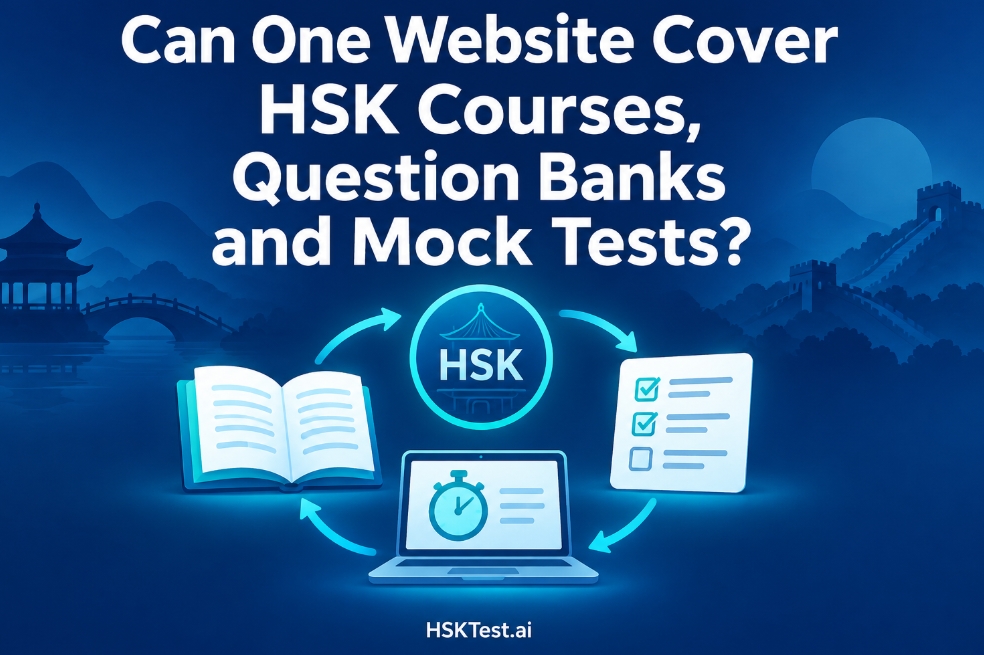
Yes, one website can cover the core stages of HSK preparation if it connects level assessment, structured courses, targeted question banks, feedback, mistake analysis, and timed mock exams.
The important issue is not whether these features appear in the same menu. They must share a consistent level system and allow the result of one activity to guide the next.
A complete HSK preparation cycle should work like this:
Assess your level → Learn the required knowledge → Practise by skill → Analyse mistakes → Take a mock exam → Adjust your study plan
If the course, question bank, and mock exam operate as separate content libraries, the learner still has to decide what to study and how to respond to each result. A genuinely integrated platform should make those connections clear.
What role does each part of an HSK platform play?
Courses, question banks, and mock exams serve different purposes. One cannot completely replace another.
What does an HSK course provide?
An HSK course builds the knowledge and skills required at a particular level.
A useful course should organise:
Vocabulary;
Grammar;
Chinese characters;
Listening;
Reading;
Speaking;
Writing;
Relevant cultural and contextual knowledge.
The course explains new material and presents it in a manageable order. It should help learners understand why a word, structure, or expression is used in a particular context.
Without a structured course, learners may answer many questions while leaving major gaps in their knowledge.
What does an HSK question bank provide?
A question bank helps learners apply what they have studied.
It can be used to:
Review one knowledge point;
Practise a specific question type;
Identify recurring mistakes;
Improve accuracy;
Increase reading or listening speed;
Become familiar with level-based tasks.
A question bank is most effective when it contains clear level labels, reliable answers, explanations, and error records.
Completing more questions does not automatically improve ability. Improvement comes from understanding why an answer was wrong and completing the right follow-up practice.
What does an HSK mock exam provide?
A mock exam checks whether knowledge and skills can be used together under test conditions.
It helps evaluate:
Overall readiness;
Performance in each section;
Time management;
Concentration;
Familiarity with the test interface;
Ability to work continuously;
Reactions to difficult questions.
The final score is only one part of the result. The more valuable information is where points were lost and what should be improved before the next test.
Why is it useful to have all three on one website?
When the three parts share learning data, they can create a more efficient preparation process.
For example:
A level assessment indicates that your general ability is near HSK 4.
The course introduces the vocabulary and grammar required at that stage.
Practice results show that sentence order and listening are your weakest areas.
The platform recommends more sentence-ordering and dictation exercises.
A mock exam shows that listening has improved but reading remains slow.
Your next study plan prioritises timed reading and vocabulary in context.
The learner does not have to transfer scores, recreate error lists, or guess which lesson relates to a missed question.
This is the main value of an all-in-one platform: continuity between activities.
What should an all-in-one HSK preparation website include?
A website does not become complete simply by advertising many features. Check whether it supports the following stages.
1. A reliable starting-level assessment
The platform should help learners determine where to begin.
A useful assessment should consider several abilities rather than only asking how long you have studied or how many words you know.
It should help answer:
Which HSK level is closest to your current ability?
Which skills are stronger?
Which skills require review?
Should you begin at the suggested level or one level below?
Which course or practice activity should come next?
The HSK level assessment on HSKTest.ai provides an initial level estimate and a personalised study report. It is a learning diagnostic rather than an official examination result.
2. Courses organised by HSK level
The course system should provide a continuous path instead of a collection of unrelated lessons.
Check whether:
The available levels are clearly shown;
Lesson difficulty develops gradually;
Vocabulary and grammar appear in context;
Listening and reading use the language taught in the course;
Speaking and writing are included where appropriate;
Each lesson leads to relevant practice.
HSKTest.ai provides level-based learning for HSK 1–9, allowing learners to continue from beginner to advanced stages within one system.
3. Several types of targeted practice
Different weaknesses need different exercises.
A learner who forgets words may benefit from flashcards. A learner who knows the words but forms unnatural sentences may need grammar and sentence-ordering exercises. Someone who recognises written vocabulary but cannot hear it may need dictation.
A practical exercise system may include:
Flashcards;
Grammar completion;
Chinese-character writing;
Sentence ordering;
Listening;
Dictation;
Reading questions;
Speaking tasks;
Writing tasks;
Level-based question banks.
The HSK practice area on HSKTest.ai brings these exercise types together so that learners can select practice according to their results.
4. Answers, explanations, and error analysis
A question bank should not end with “correct” or “incorrect.”
Useful feedback should reveal whether the mistake came from:
Missing vocabulary;
Confusion between similar words;
Weak grammar;
Incorrect sentence order;
Failure to recognise spoken language;
Slow reading;
Misunderstanding the task;
Poor time management.
Error analysis becomes more valuable when it leads directly to a related lesson or practice set.
5. Speaking and writing feedback
Speaking and writing are difficult to evaluate independently.
A complete platform should help learners review areas such as:
Pronunciation;
Tones;
Fluency;
Grammar;
Word choice;
Sentence structure;
Organisation;
Clarity.
HSKTest.ai includes AI-assisted speaking assessment and writing correction in its practice section. This allows learners to receive feedback more frequently and revise their answers.
AI feedback can support repeated daily practice. Teachers remain valuable for nuanced expression, cultural context, and complex communication.
6. Timed mock exams
The mock-exam section should reproduce important test conditions rather than provide only another set of questions.
Look for:
Clear level selection;
Relevant test sections;
Time limits;
Listening audio;
Continuous test flow;
Immediate results;
Section-level analysis;
Error records;
Recommended follow-up practice.
The HSK mock-exam section on HSKTest.ai provides timed HSK-style tests, immediate results, and performance analysis.
Candidates should still confirm the latest examination syllabus, format, dates, and registration requirements through the official examination provider or their local test centre.
How should courses, question banks, and mock exams be used together?
A common mistake is to use all three resources in the wrong order.
Some learners begin with full mock exams before they have studied the target-level content. Others complete a whole course without testing whether they can answer questions independently. Some spend months using a question bank without ever practising a complete timed exam.
A more effective process has four stages.
Stage 1: Diagnose
Begin with a level assessment or a short diagnostic test.
The goal is to identify:
Your likely starting level;
Your target level;
Missing foundations;
Weak skills;
Available study time.
Stage 2: Learn
Use the course to build the knowledge required at your current stage.
For every lesson:
Learn the new vocabulary or grammar.
Study several examples.
Listen to or read the language in context.
Produce your own sentence or response.
Complete a short exercise.
Stage 3: Practise
Use the question bank and specialised exercises to turn knowledge into reliable performance.
Do not select questions randomly. Choose them according to:
The lesson you have just completed;
A weakness shown in your results;
A question type you find difficult;
Errors from a previous mock exam.
Stage 4: Test and adjust
Take a mock exam after a meaningful block of study.
After the test:
Review performance by section.
Classify each important error.
Identify the two or three largest weaknesses.
Return to the related lessons and exercises.
Set a date for the next progress check.
This creates a cycle rather than a one-way course.
Can one platform create a personalised HSK study plan?
It can, provided the recommendations are based on learning evidence.
A useful personalised plan should use information such as:
Current level;
Target HSK level;
Test date;
Performance by skill;
Frequently missed knowledge points;
Available study time;
Recent progress.
Personalisation should affect what the learner does next. Simply displaying the learner’s name above a standard course is not meaningful personalisation.
For example:
Weak listening should lead to more listening and dictation;
Poor sentence order should lead to grammar and ordering exercises;
Slow reading should lead to timed reading practice;
Weak writing should lead to short writing tasks and revision;
A low mock-exam score caused by time pressure should lead to timed sections.
How can you evaluate whether the three systems are truly connected?
Try this practical test before committing to a platform.
Complete one lesson
Check whether the platform recommends related exercises after the lesson.
Answer several questions incorrectly
See whether your mistakes are recorded and classified.
Open your progress report
Check whether the report separates vocabulary, grammar, listening, reading, speaking, or writing where relevant.
Start a practice session
See whether the platform uses your previous mistakes to suggest content.
Review a mock-exam result
Check whether the result links to a lesson, skill, or question type that needs improvement.
If every section works independently, the website may contain many resources without providing an integrated learning path.
What are the warning signs of an incomplete HSK platform?
Be cautious if a website:
Calls a vocabulary list a complete HSK course;
Provides questions without explanations;
Has no listening audio for listening practice;
Offers mock exams with no time limits;
Shows only total scores;
Does not record mistakes;
Provides no speaking or writing feedback;
Mixes levels without clear labels;
Uses the same exercises for every learner;
Claims that completing a certain number of questions guarantees a pass.
A platform should make preparation clearer, not create another unorganised content library.
Does one website replace teachers and authentic Chinese?
No. An all-in-one HSK platform can cover the main preparation process, but it does not have to replace every learning experience.
Learners can still benefit from:
Teachers for detailed explanation and guidance;
Language partners for natural interaction;
Chinese videos and podcasts for authentic listening;
News and graded readers for broader reading;
Real conversations for spontaneous communication;
Official sources for current examination information.
The platform can act as the centre of the study plan, while these resources provide additional input and communication experience.
Who benefits most from an all-in-one HSK platform?
Beginners who do not know where to start
A level assessment and structured course reduce the need to select every resource independently.
Self-learners with limited feedback
AI-supported speaking, writing, and error analysis can provide more frequent guidance.
Learners preparing within a fixed period
A connected system makes it easier to prioritise weak skills and monitor readiness.
Learners who repeatedly take mock exams without improving
Linking test results to lessons and targeted practice helps turn measurement into improvement.
Learners using too many unrelated applications
One central platform can organise courses, exercises, mistakes, and test results in the same learning path.
How does HSKTest.ai create a complete preparation cycle?
HSKTest.ai connects the main stages of HSK preparation:
Level assessment;
HSK 1–9 courses;
Vocabulary and grammar learning;
Listening and reading practice;
Character writing and sentence ordering;
Dictation;
AI speaking assessment;
AI writing feedback;
Level-based question banks;
Weakness analysis;
Timed mock exams;
Progress tracking.
The complete cycle can be summarised as:
Find your level → Study the course → Complete targeted practice → Review feedback → Take a mock exam → Strengthen weak areas
This allows the result of one activity to influence the next stage instead of leaving the learner with only a score.
Frequently Asked Questions
Can I prepare for HSK entirely on one website?
You can complete most core preparation activities on a well-designed platform, including assessment, courses, exercises, question banks, feedback, and mock exams. Authentic Chinese input and real communication remain useful supplements.
Should I finish the course before using the question bank?
No. Complete related practice after each lesson. Use broader question-bank sets after finishing a unit or group of knowledge points.
How often should I take a full HSK mock exam?
Take full mock exams at meaningful checkpoints. Between exams, use targeted practice to improve the weaknesses identified in the previous report.
Is a large question bank always better?
No. Question quality, level accuracy, explanations, variety, and mistake analysis are more important than the total number of questions.
Can a mock-exam score predict my official HSK result?
It can indicate readiness, but it cannot guarantee an official score. The quality of the mock test, test-day performance, and differences in format may affect the result.
What if my course level and mock-exam result are different?
Review your skill results. You may understand the course content but lack speed, test familiarity, listening accuracy, or writing practice. Use the weakest section to plan targeted review.
Do I need AI feedback for HSK preparation?
AI feedback is especially useful for frequent speaking and writing practice and for classifying errors. It is a learning aid rather than an official score or a complete replacement for teachers.
What should I do first on HSKTest.ai?
Start with the level assessment if you are unsure of your current stage. Then enter the recommended course, complete relevant practice, and use a mock exam after a period of targeted learning.
One website can cover the core process when its features are connected
An all-in-one HSK preparation website can provide courses, question banks, feedback, and mock exams. The value comes from how these parts work together.
The course teaches the knowledge. The question bank turns knowledge into practice. Feedback explains the mistakes. The mock exam measures whether everything can be used under realistic conditions. The result then creates the next study plan.
You can try this complete cycle on HSKTest.ai, beginning with an assessment and continuing through level-based learning, targeted practice, AI feedback, and mock exams.
The goal is not to keep every HSK resource on one screen. It is to make sure every learning result leads to a useful next step.


